Peace symbols
Peace symbols and what they mean
Six signs that are understood all over the world as symbols of peace, and the stories they come from
Key points at a glance
- The best-known signs of peace are the dove, the olive branch, the sign in the circle, the rainbow flag, the pipe and the image of swords beaten into ploughshares.
- The dove, the olive branch and the swords come from the Bible; the sign in the circle and the flag were designed in 1958 and 1961 for peace marches.
- The pipe comes from ceremonies of Indigenous peoples of North America and was heavily simplified in Europe.
- Most of these signs belong to no one, and the man who drew the sign in the circle deliberately left it unprotected.
Antiquity
Dove and olive leaf
In the story of the Flood, a dove returns to the ark with a fresh olive leaf.
1946
The UN’s olive branches
The United Nations adopts its emblem: the world map in a wreath of olive branches.
1949
Picasso’s dove
A lithograph by Pablo Picasso becomes the poster of the World Peace Congress in Paris.
1958
Sign in the circle
Gerald Holtom designs the sign for a march against nuclear weapons.
1961
Rainbow flag
Aldo Capitini has a flag of seven stripes sewn for the march from Perugia to Assisi.
1980
Swords into ploughshares
Youth pastor Harald Bretschneider designs the symbol for the church’s peace work in the GDR.
- from the Bible3
- designed for peace marches2
- from ceremonies of Indigenous peoples1
The symbols compared
| Symbol | Origin | Recorded since | Stands for today |
|---|---|---|---|
| Peace sign | Great Britain, Campaign for Nuclear Disarmament (CND) | 21 February 1958 | Peace, disarmament, protest against war |
| Dove of peace | Bible, the story of Noah and the flood | antiquity, as a political sign since 1949 | Peace, reconciliation, hope |
| Olive branch | Mediterranean, Bible | antiquity | Peace, reconciliation, an outstretched hand |
| Peace flag | Italy, peace march from Perugia to Assisi | 24 September 1961 | Peace, nonviolence |
| Peace pipe | Indigenous peoples of North America | long before the arrival of Europeans | Alliance, prayer, community |
| Swords into ploughshares | Bible, books of Isaiah and Micah | Old Testament, as a patch since 1980 | Disarmament, peace without weapons |
Some of these signs are thousands of years old, others were designed on a particular day by a particular person. The dove and the olive branch come from the story of the flood, the peace sign from a march against nuclear weapons in 1958, the rainbow flag from a peace march in Italy in 1961, the pipe from the ceremonies of Indigenous peoples of North America, the image of swords beaten into ploughshares from the Book of Isaiah and the peace movement of the GDR. Each entry follows the same questions: what the sign shows, where it comes from, how it spread and what is worth knowing before you use it. All graphics on these pages are our own drawings.
The symbols
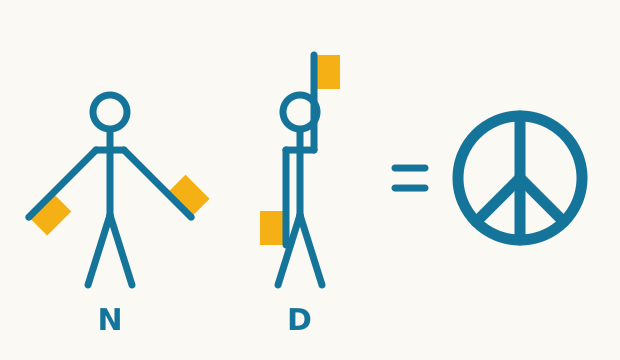
Peace, disarmament, protest against war
Peace sign
A circle, one vertical line and two slanted ones: designed in 1958 for a march against nuclear weapons, today the best known peace sign in the world
View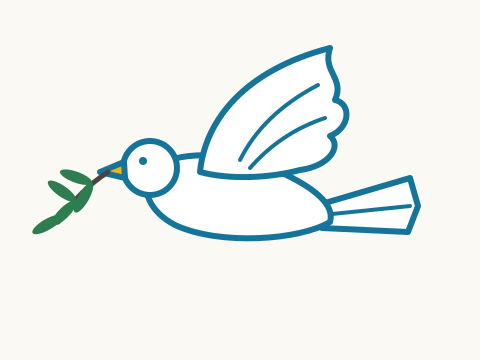
Peace, reconciliation, hope
Dove of peace
A white dove, often with a branch in its beak: an image from the story of the flood that Pablo Picasso turned into the sign of a worldwide movement in 1949
View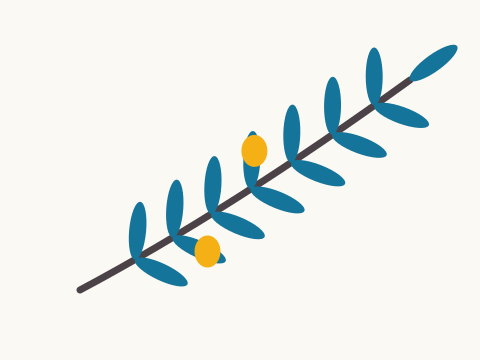
Peace, reconciliation, an outstretched hand
Olive branch
A branch of the olive tree that has stood for the end of a danger since the story of the flood and today frames the world map of the United Nations
View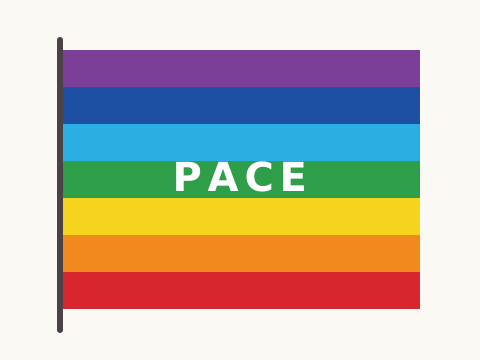
Peace, nonviolence
Peace flag
Seven stripes in the colours of the rainbow, violet on top: sewn for a peace march in Italy in 1961, today on balconies and at demonstrations in many countries
View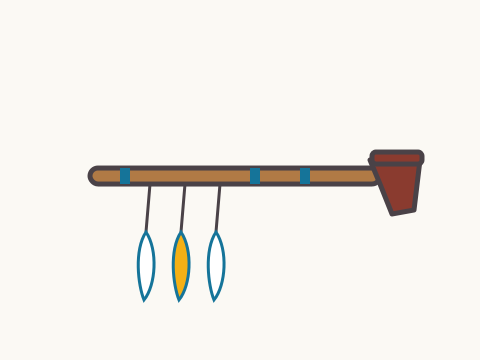
Alliance, prayer, community
Peace pipe
A sacred object of Indigenous peoples of North America that sealed alliances and carried prayers, and that Europe simplified into the peace pipe
View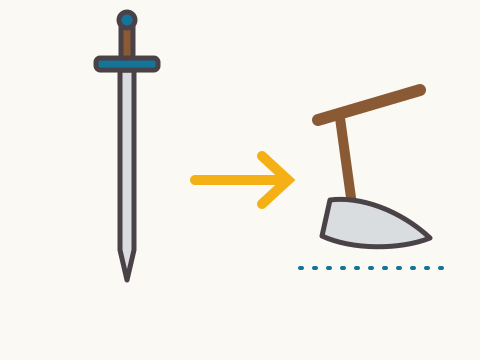
Disarmament, peace without weapons
Swords into ploughshares
A sentence from the Bible, a bronze figure at the United Nations and a patch that got young people in the GDR into trouble
View
Which other signs stand for peace?
Besides the six signs in this series there are others that are often named. One of them even has a legal meaning: the white flag. Article 32 of the Hague Regulations of 1907 describes the parlementaire, a person authorised by one party to a war to communicate with the other, who advances bearing a white flag. He is inviolable, and so are those who accompany him. The white flag therefore does not stand for peace as such, but for the wish to talk.
A second sign is the gesture with two spread fingers. It goes back to a radio appeal by the Belgian Victor de Laveleye in January 1941 and first stood for victory and freedom, later also for peace. And as early as 1912 the American pastor James Van Kirk designed a World Peace Flag of seven colours with the earth in the middle, which according to the Italian magazine Sapereambiente was adopted at a peace conference in The Hague in 1913.
Images that grew and signs that were designed
The signs in this series fall into two groups. Some grew over centuries: the dove and the olive leaf come from the story of the flood, the image of swords and ploughshares from the books of Isaiah and Micah, the pipe from the religious life of Indigenous peoples. Nobody invented them, and their meaning has shifted with every generation.
The others were designed on a particular day for a particular purpose. Gerald Holtom drew the sign in the circle in February 1958 for a march against nuclear weapons, Aldo Capitini had the rainbow flag sewn for the march from Perugia to Assisi in September 1961, and a team led by Oliver Lincoln Lundquist designed the United Nations emblem with its olive branches in 1945.
Often the two groups meet. In 1949 Picasso took the old dove and turned it into the poster of a congress, and in 1980 the peace movement in East Germany put a sentence from the Bible on a patch. It is this pairing of an old image and a new occasion that makes many signs last so long.
What the Bible contributes to these signs
Several. The dove with the freshly plucked olive leaf appears in chapter eight of Genesis, the rainbow as the sign of the covenant in chapter nine. The image of swords beaten into ploughshares is found in the prophets Isaiah and Micah, and at the baptism of Jesus in the Gospel of Matthew the Spirit of God descends like a dove.
This origin explains why the signs are so common in churches. It does not explain who uses them today: the dove, for example, became one of the most common political symbols in East Germany, a state hostile to the church.
The root lies in the story of the flood. After the waters God sets his bow in the clouds as the sign of his covenant with the earth, so that there will be no more flood. In its peace education material the Protestant Church in the Rhineland explains it as a promise to keep peace with people, together with the task that people should also live in peace with one another.
Today the rainbow appears above all in the colours of the peace flag. Whether its designer Aldo Capitini was thinking of the flood is not documented.
Frequently asked questions
Which symbol stands for peace?
There is no single symbol. The best known worldwide are the white dove and the sign in the circle with its three lines. The German Patent and Trade Mark Office counts this sign among the few symbols that are known all over the world and understood everywhere.
Which sign someone chooses depends on the occasion and on the tradition they come from. The dove and the olive branch come from the Bible, the sign in the circle and the rainbow flag from peace marches, the olive branches of the United Nations from the emblem of an organisation. On this page you will find all six signs in the series with their origins.
Which signs are typical of the peace movement?
Since 1958 the sign in the circle has belonged to the British Campaign for Nuclear Disarmament, whose march to Aldermaston, according to the German Patent and Trade Mark Office, started the tradition of Easter marches. The rainbow flag with the word PACE comes from the Italian movement for nonviolence.
In 1949 Picasso’s dove was the poster of the World Peace Congress in Paris. In East Germany the independent peace movement wore the patch “Swords into Ploughshares” from 1980. Each movement has its sign, and many of them were later taken up by others.
Which way up does the sign in the circle go?
The vertical line runs through the middle of the circle, and the two slanted lines branch off from the centre downwards. That is how Gerald Holtom drew it in 1958, and it fits his explanation: the arms pointing down form the letter N in semaphore.
A version with the lines pointing up is not one of Holtom’s variants. According to the German Patent and Trade Mark Office, the claim that it is a “death rune” comes from the Nazi era and has nothing to do with the design.
Which signs of peace exist as emoji?
The international character set Unicode lists several of them under their own names: the sign in the circle as U+262E PEACE SYMBOL, the dove as U+1F54A DOVE OF PEACE, the two-finger gesture as U+270C VICTORY HAND and the white flag as U+1F3F3 WAVING WHITE FLAG.
What these characters look like depends on the font and the device that displays them. The same character is meant everywhere, even if the dove is drawn differently on one phone than on another.
May these signs be used freely?
For the sign in the circle, yes. Gerald Holtom deliberately chose not to protect it, and the British Campaign for Nuclear Disarmament writes that no one has to pay or ask permission. The dove, the olive branch and the rainbow flag are old motifs without an owner.
The patch “Swords into Ploughshares” in its East German design is different. According to the Ecumenical Peace Decade, in 2006 it asked the Aktionsgemeinschaft Dienst für den Frieden to protect this motif so that it is used mainly in peace work. With the pipe the question is less about rights than about respect for a sacred object.
What turns an image into a sign of peace?
An image becomes a sign when many people use it in the same meaning for long enough. The dove was first part of a story, the sign in the circle first the logo of a campaign. Only through repetition on posters, flags and badges did they become signs that are understood without explanation.
That is also why the meaning can shift. The same sign can stand for a particular movement in one country and for peace in general in another, and it can be used by groups its creators never had in mind.
From a sign to a mission of your own
A symbol says what someone stands for. What comes of it is decided where people start something together: in a neighbourhood, a school, a club. On W3ltfrieden you will find missions where exactly that happens.
Find your peace mission