Peace symbols
Swords into ploughshares
A sentence from the Bible, a bronze figure at the United Nations and a patch that got young people in the GDR into trouble
Key points at a glance
- The sentence comes from the Bible, almost word for word in the prophets Isaiah (2:4) and Micah (4:3).
- It describes disarmament as transformation: weapons become tools for the field.
- In 1959 the Soviet Union gave the United Nations a bronze statue with this motif.
- In East Germany the patch became the sign of the independent peace movement from 1980; wearing it was banned on 22 March 1982.
- To this day the motif accompanies the Ecumenical Peace Decade every November.
In numbers
1959
sculpture at the UN
presented on 4 December
1980
symbol of the GDR movement
designed by Harald Bretschneider
2,000
spectators in Wittenberg
when a sword was reforged in 1983
- Promise in Micah, 8th century BCover 2,700 years
- Sculpture at the UN, 195967 years
- Symbol by Harald Bretschneider, 198046 years
- Forging in Wittenberg, 198343 years
A sign without paper
Youth pastor Harald Bretschneider looks for a sign for the church’s peace work that escapes state censorship.
The gap in the law
In the GDR every leaflet and every poster needs a printing permit. Printed fabrics do not count as printed matter.
Printed on fleece
In 1981 Hans-Michael Wenzel in Herrnhut prints textile bookmarks for the regional church. By 1982 more than 100,000 have left the workshop.
On parkas and bags
Young people attach the prints to their parkas and bags. This turns the bookmark into the patch of the peace movement.
The ban
On 22 March 1982 wearing it in public is banned. Anyone who wears the patch risks expulsion from school or university.
- Origin
- Bible, books of Isaiah and Micah
- Recorded since
- Old Testament, as a patch since 1980
- Creator
- as a patch, youth pastor Harald Bretschneider
- Stands for today
- Disarmament, peace without weapons
- Author
- Johannes Max Harms
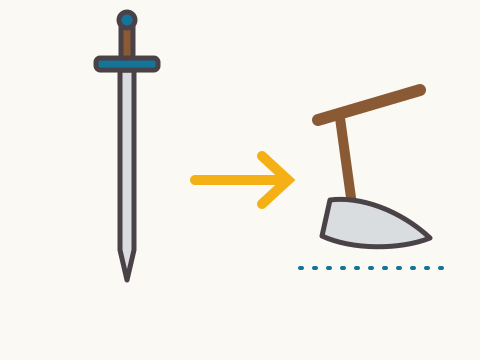
What does swords into ploughshares mean?
The phrase describes a disarmament that is more than a ceasefire: weapons are not just laid down but reforged into tools for working a field. A ploughshare is the iron that breaks up the soil when ploughing.
The image joins two thoughts. What was made for killing then serves life, and the material stays the same. Peace does not come out of nothing, but out of what served war before.
As a motto the phrase is still widespread today, in churches, in the peace movement and in politics. In Germany it is closely tied to the independent peace movement of the GDR.
Where is the phrase in the Bible?
The phrase appears twice in the Old Testament, almost word for word: in the prophet Isaiah, chapter two, and in the prophet Micah, chapter four. Both describe a time when peoples have their disputes settled instead of going to war.
In the King James Version, Isaiah says they shall beat their swords into plowshares and their spears into pruninghooks, nation shall not lift up sword against nation, neither shall they learn war any more.
The last part matters. It is not only about reworking the weapons but about unlearning war. In it lies the thought that peace is also a matter of upbringing and habit.
What does the sculpture at the UN have to do with it?
On 4 December 1959 the Soviet Union presented the United Nations with a bronze figure by the sculptor Yevgeny Vuchetich. It stands in the north garden of the headquarters in New York and bears the title "Let Us Beat Swords into Ploughshares".
The figure shows a man holding a hammer in one hand and in the other a sword that he is making into a ploughshare. The United Nations describe it as an image of humankind’s wish to end war and turn the means of destruction into tools.
In the middle of the Cold War the gift was also a political gesture. That the GDR peace movement later made this very figure its sign gave the patch a particular edge: it showed a gift from the GDR’s closest ally.
How did the patch become a sign in the GDR?
In 1980 the Saxon youth pastor Harald Bretschneider developed the symbol for the church’s peace work. It shows the figure at the UN, the man reforging a sword, together with the words "Schwerter zu Pflugscharen".
The motto first appeared at church peace events. According to jugendopposition.de, run by the Federal Agency for Civic Education and the Robert Havemann Society, it reached the wider public as a patch from 1981. Young people above all wore it on their jackets.
According to the House of History, the churches were the only larger organisations in the GDR that could keep a measure of independence from the state. That is why a patch from a church initiative became the most visible sign of the independent peace movement.
How did the state react to the sign?
When the sign became a protest symbol in 1981, the state, according to jugendopposition.de, cracked down hard on those who wore it. Patches were torn off young people’s jackets; a photo in the Robert Havemann Society’s collection shows a parka with a torn-off patch.
One action became famous at the church congress in Wittenberg on 24 September 1983. In the Luther courtyard the blacksmith Stefan Nau reforged a sword into a vintner’s knife with hammer and anvil in front of about 2,000 spectators. Because a West German television crew was there, many people saw it.
According to the DDR Museum, the peace groups of the 1980s became the nucleus of the movement that led to the Peaceful Revolution in autumn 1989. The sign is therefore part of the history of German unity today.
How old is the sentence?
According to the Ecumenical Peace Decade, the prophet Micah proclaimed his promise in the 8th century BC; it appears almost word for word in the book of Isaiah.
According to the same source, the Septuagint, the ancient Greek translation of the Old Testament, even speaks specifically of swords becoming pruning knives. The sentence has thus been in circulation for well over 2,000 years.
Who organised the forging in Wittenberg?
According to MDR, the action in the Luther courtyard on 24 September 1983 was organised by the theologian Friedrich Schorlemmer during the Protestant Church Congress. A real sword was reworked; the smith at the anvil was Stefan Nau.
According to MDR, the picture went around the world and later became a symbol of the peace movement in East and West. For many people outside East Germany it was the first time they heard of the sign.
Isaiah 2:4, King James Version
They shall beat their swords into plowshares, and their spears into pruninghooks: nation shall not lift up sword against nation, neither shall they learn war any more.
Sources
- King James Version: Isaiah 2
- Luther Bible 2017: Micah 4
- UN Photo: Sculpture "Let Us Beat Swords into Ploughshares"
- jugendopposition.de (bpb and Robert Havemann Society): the peace movement in the GDR
- House of History, LeMO: patch "Schwerter zu Pflugscharen"
- DDR Museum: Die eherne Friedenstaube
- Luther Bible 2017: Joel 4
- DWDS: Pflugschar
- MDR: Swords into Ploughshares, how a bookmark from Herrnhut challenged East Germany
- Ecumenical Peace Decade: Schwerter zu Pflugscharen
Milestones of the sign
- Old TestamentThe prophets Isaiah and Micah speak of peoples who beat their swords into ploughshares.
- 4 Dec 1959The Soviet Union presents the bronze figure by Yevgeny Vuchetich to the United Nations.
- 1980The Saxon youth pastor Harald Bretschneider develops the symbol for the church’s peace work.
- 1981As a patch the sign reaches the public, and the state acts against those who wear it.
- 24 Sep 1983In the Luther courtyard in Wittenberg Stefan Nau reforges a sword in front of 2,000 spectators.
More peace symbols
- Dove of peacePeace, reconciliation, hopeA white dove, often with a branch in its beak: an image from the story of the flood that Pablo Picasso turned into the sign of a worldwide movement in 1949
- Peace signPeace, disarmament, protest against warA circle, one vertical line and two slanted ones: designed in 1958 for a march against nuclear weapons, today the best known peace sign in the world
Frequently asked questions about the motif
What is a ploughshare?
The German dictionary DWDS explains the Pflugschar as the iron on a plough that cuts horizontally through the earth. The word is old: Old High German already had scar for the cutting iron, related to the verb scheren, to shear.
The usual German form is feminine, with the plural Pflugscharen, and there is also a neuter variant. In the biblical image what matters is that sword and ploughshare are made of the same material: iron that can be forged into something else.
Does the sentence also exist the other way round?
Yes. In the fourth chapter of the prophet Joel the Luther Bible reads: “Beat your ploughshares into swords and your pruning hooks into spears!” The verse is a call to war, and at this point the Luther Bible itself refers to Isaiah 2:4.
So the Bible knows both directions. The peace movement deliberately invoked Isaiah and Micah, the promise that nations will unlearn war.
Who designed the motif?
The idea of using the sentence with the statue at the UN as a sign came from Harald Bretschneider, then youth pastor of the Saxon regional church. The Haus der Geschichte names Ingeborg Geißler and Herbert Sander for the graphic design of the patch.
It was printed in Herrnhut by Hans-Michael Wenzel, who otherwise made net curtains, drapes and tablecloths in his small business. In 1981 the Protestant regional church commissioned him to make textile bookmarks for the Peace Decade.
Why was the patch printed on fabric?
Because of censorship. According to MDR, in East Germany every leaflet and every poster needed a print permit number. Printed textiles, however, did not count as printed matter under the regulation.
Bretschneider and Wenzel used this gap and printed on non-woven fabric. By 1982 more than 100,000 copies had left the workshops in Herrnhut. Young people sewed them onto parkas and bags.
Was the patch banned?
Yes. According to MDR, wearing the motif in public was officially prohibited on 22 March 1982. The security services treated the patch as an expression of hostility to the state, and anyone who wore it risked expulsion from school or university.
The Stasi searched Wenzel’s business and seized the documents. It overlooked the printing blocks, and by his own account Wenzel secretly went on printing, “hidden behind unsuspicious curtains”.
The leadership made no secret of its reasons. “Socialism needs ploughshares and swords,” Defence Minister Heinz Hoffmann told the People’s Chamber, according to MDR.
Is the sign still used today?
Yes, above all in the Ecumenical Peace Decade. Every November parishes and peace initiatives use ten days for services, discussions and actions, and the logo has accompanied this work for decades.
So that the motif is not commercialised at will, in 2006 the forum of the Peace Decade asked the Aktionsgemeinschaft Dienst für den Frieden to protect it, with the agreement of its designers. The image was also taken up outside Germany, for example by the Christian Plowshares movement in the United States.
From a sign to a mission of your own
A symbol says what someone stands for. What comes of it is decided where people start something together: in a neighbourhood, a school, a club. On W3ltfrieden you will find missions where exactly that happens.
Find your peace mission