Peace symbols
Dove of peace
A white dove, often with a branch in its beak: an image from the story of the flood that Pablo Picasso turned into the sign of a worldwide movement in 1949
Key points at a glance
- The dove as a sign of peace comes from the story of the flood: it brings Noah a freshly plucked olive leaf.
- In the New Testament the dove also stands for the Spirit of God.
- Pablo Picasso created a dove for the World Peace Congress in Paris in 1949; since then it has been a worldwide political image.
- In East Germany it was one of the most common political symbols, sung about in the song of the “little white dove of peace”.
- The dove has no creator and no owner; what it means depends on who shows it.
In numbers
1949
Picasso’s dove
poster for the peace congress in Paris
3
flights from the ark
the second with an olive leaf
1987
dove at the Nikolaiviertel
a house wall in Berlin
The flood
- Where it is found
- Genesis 8
- What the dove does
- returns with a freshly plucked olive leaf
- Meaning
- end of the flood, reconciliation
Baptism of Jesus
- Where it is found
- Matthew 3
- What the dove does
- descends as the Spirit of God
- Meaning
- Holy Spirit
Picasso 1949
- Where it is found
- poster of the World Peace Congress in Paris
- What the dove does
- stands for a movement
- Meaning
- peace as a political aim
First a raven
After forty days Noah opens the window of the ark and lets a raven fly. It flies to and fro until the waters have dried up.
The dove comes back
Then Noah lets a dove fly. It finds nowhere to rest its foot and returns to the ark.
The fresh olive leaf
Seven days later it flies again and comes back in the evening with a fresh olive leaf in its beak. From this Noah knows that the water is going down.
It stays away
After another seven days the dove flies once more and does not return. Soon after, the waters on the earth have dried up.
- Origin
- Bible, the story of Noah and the flood
- Recorded since
- antiquity, as a political sign since 1949
- Creator
- no single one; modern form by Pablo Picasso
- Stands for today
- Peace, reconciliation, hope
- Author
- Johannes Max Harms
What does the dove of peace stand for?
The dove of peace stands for peace, reconciliation and hope. It is usually shown white, in flight and with an olive branch in its beak. In this form it is one of the oldest signs of peace of all and at the same time one of the best known today.
Unlike the peace sign it has no single creator. Its meaning has grown over centuries from several layers: from the story of the flood, from Christian imagery and from the politics of the 20th century.
That is why it is used in very different ways, in church services as well as on the posters of movements that have nothing to do with religion. What a dove means in a given case depends on who shows it and where.
Where does the dove as a sign of peace come from?
The origin is the story of Noah in the Book of Genesis. After the flood Noah sends a dove out of the ark three times. The first time it finds no place to rest and comes back, the second time it brings back a fresh olive leaf in the evening, the third time it does not return.
The olive leaf shows Noah that the water is going down and the land is growing green again. The DDR Museum in Berlin sums up the reading like this: the dove became the symbol of reconciliation between God and humankind.
The New Testament adds a second meaning. At the baptism of Jesus in the Jordan, according to the Gospel of Matthew, he sees the Spirit of God descending "like a dove". Since then the dove has also been the image of the Holy Spirit in Christian art.
Why does the dove have a branch in its beak?
The branch in its beak comes straight from the story of the flood: it is the fresh olive leaf the dove brings back to Noah. It shows that the danger has passed and life goes on. In imagery the leaf has become a whole branch.
This joins two signs of peace in one image. The olive branch is a sign of peace in its own right, for example in the emblem of the United Nations, which sets the map of the world in a wreath of olive branches.
A dove without a branch can mean the same, but is read more openly. Only the branch makes clear that what is meant is not love, purity or a messenger, but the end of a disaster and a new beginning.
What role did Picasso play?
Pablo Picasso made a lithograph of a dove in 1949. According to the Victoria and Albert Museum in London, he designed it for the World Peace Congress, the Congrès mondial des partisans de la paix, held in Paris that year. Picasso’s dove and its biblical allusion to the end of the flood came to symbolise peace in the second half of the 20th century.
According to the DDR Museum, the motif was chosen by the writer Louis Aragon, one of the organisers of the congress. He saw the drawing in his friend’s studio and suggested making it the image of the congress.
The dove quickly became contested. The World Peace Movement was close to the Soviet Union, and in the early 1950s the French group Paix et Liberté took up the motif in posters of its own to warn against communism. Picasso did not invent the dove, but he shaped its modern form.
Where does the dove appear today?
The dove appears on posters, flags and badges, in church windows and on song sheets, in schools and at memorials. Because it is understood without words, it suits occasions where people of different languages come together.
In the GDR it was one of the most frequent political images. A poster with the dove inspired the kindergarten teacher Erika Schirmer from Nordhausen to write the song of the "little white dove of peace", which generations of children sang. In 1987 a dove with the inscription "Berlin – City of Peace" was put up at Berlin’s Nikolaiviertel.
This very example shows that a sign alone guarantees nothing. The DDR Museum points to the contradiction between the rhetoric of peace and the Wall; the independent peace movement of the GDR therefore chose a sign of its own, "Swords to Ploughshares".
Since when has the word existed in German?
The German word Friedenstaube is much older than Picasso’s poster. The German Dictionary of the Brothers Grimm lists it in its fourth volume, whose first instalment appeared in 1863, and illustrates it with verses: “süsze liebe friedenstaube, / die du schnell den ölzweig bringst”, sweet dear dove of peace that swiftly brings the olive branch.
Even then, dove and olive branch belonged firmly together in German. Picasso and the World Peace Movement did not invent the image in 1949; they gave an old word a new political stage.
Genesis 8:11, King James Version
And the dove came in to him in the evening; and, lo, in her mouth was an olive leaf pluckt off: so Noah knew that the waters were abated from off the earth.
Sources
- King James Version: Genesis 8
- Luther Bible 2017: Matthew 3
- Victoria and Albert Museum: poster "Jo-Jo La Colombe", with a note on Picasso’s dove
- Tate: Pablo Picasso, Dove, 1949
- DDR Museum: Die eherne Friedenstaube
- Sapereambiente: Com’è nata la bandiera della pace?
- Unicode Character Database: UnicodeData.txt
- German Dictionary by Jacob and Wilhelm Grimm: friedenstaube (DWDS)
Milestones of the sign
- antiquityIn the story of the flood a dove returns to the ark with a fresh olive leaf.
- New TestamentAt the baptism of Jesus the Spirit of God descends "like a dove".
- 1949Pablo Picasso’s lithograph of a dove becomes the poster of the World Peace Congress in Paris.
- early 1950sThe French group Paix et Liberté takes up the dove in posters against communism.
- 1987In Berlin a dove with the inscription "Berlin – City of Peace" is put up at the Nikolaiviertel.
More peace symbols
- Olive branchPeace, reconciliation, an outstretched handA branch of the olive tree that has stood for the end of a danger since the story of the flood and today frames the world map of the United Nations
- Swords into ploughsharesDisarmament, peace without weaponsA sentence from the Bible, a bronze figure at the United Nations and a patch that got young people in the GDR into trouble
Frequently asked questions about the dove
Who wrote the song of the little white dove?
The song “Kleine weiße Friedenstaube”, little white dove of peace, was written and composed by the kindergarten teacher Erika Schirmer from Nordhausen. According to the DDR Museum, a poster with the dove gave her the idea.
The simple melody and plain words made the song an earworm for a whole generation; hardly any other song was sung as often in East Germany. At the same time the DDR Museum points out the contradiction of a heavily armed state singing about peace all the time.
Did Picasso draw more than one dove?
Yes. The best known is the 1949 lithograph for the World Peace Congress in Paris. According to the magazine Sapereambiente, Picasso drew a dove again for the poster of the 1952 congress in Vienna, this time above a rainbow.
Others took up the motif too. In the early 1950s the French group Paix et Liberté used the dove in its own anti-communist posters, as the Victoria and Albert Museum shows with one example. Picasso’s image was contested from the start.
Is the dove a Christian sign?
Its roots lie in the Bible, in the story of the flood and in the baptism of Jesus. But it is used far beyond churches. The DDR Museum describes how, of all states, the church-hostile East German one made the dove one of its most common symbols.
The reason was political. The Soviet-led World Peace Movement wanted to signal non-partisanship, and an image many people knew from the Bible suited that. Today groups of very different backgrounds use the dove, religious and non-religious alike.
How do you draw a simple dove?
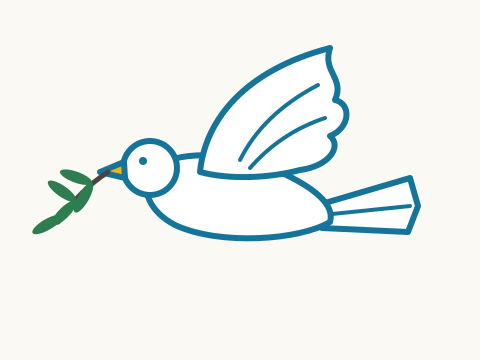
It is easiest in profile: an oval body, a small round head at the front top, a pointed beak and a fan-shaped tail at the back. Attach the wings to the top of the body, one swept upwards and the other slightly behind it, so that the dove is flying.
For the peace motif, add a short twig with a few narrow leaves to the beak. Picasso’s doves show that a few clear lines are enough; the image needs no shading. Our own drawing at the top of this page follows the same structure.
Is there a dove emoji?
Yes. In the international character set Unicode it has its own place, named DOVE OF PEACE, with the number U+1F54A. The name shows how firmly dove and peace are linked: Unicode does not simply call it a dove but a dove of peace.
What the dove looks like on screen depends on the device and the font. The same character is meant everywhere.
What does the dove mean as a tattoo?
As with any tattoo, the person wearing it decides what it means. The dove, however, is one of the motifs with a clear visual language: peace, reconciliation and hope, especially when it is flying and carries a twig in its beak.
Without the twig it is read more openly, for example as a sign of freedom, love or faith, because in Christian art the dove also stands for the Holy Spirit. Anyone who wants an unambiguous meaning of peace is best served by the dove with the twig.
From a sign to a mission of your own
A symbol says what someone stands for. What comes of it is decided where people start something together: in a neighbourhood, a school, a club. On W3ltfrieden you will find missions where exactly that happens.
Find your peace mission