Peace symbols
Olive branch
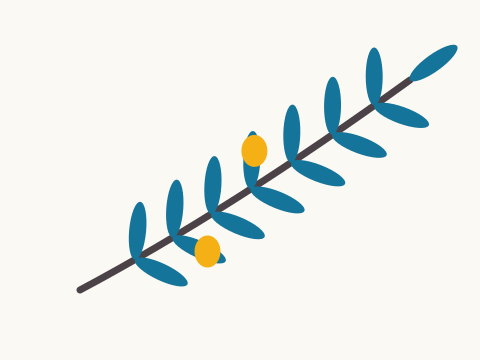
A branch of the olive tree that has stood for the end of a danger since the story of the flood and today frames the world map of the United Nations
Key points at a glance
- The olive branch stands for peace and reconciliation.
- Its best-known source is the story of the flood: a dove brings Noah a freshly plucked olive leaf.
- Since 1946 the United Nations has placed two crossed olive branches around its map of the world.
- Holding out an olive branch means offering peace after a quarrel.
In numbers
1946
UN emblem adopted
on 7 December, with olive branches
1947
UN flag
approved on 20 October
2
branches in the UN emblem
crossed around the world map
Story of the flood
- Since when
- antiquity
- Form
- a freshly plucked olive leaf in a dove’s beak
- Meaning
- the flood is over
United Nations emblem
- Since when
- 1946
- Form
- two crossed branches around a map of the world
- Meaning
- hope for peace and unity
Figure of speech
- Since when
- widespread today
- Form
- holding out an olive branch
- Meaning
- first step towards reconciliation
The emblem
- A map of the world seen from the North Pole, with the pole at the centre.
- A wreath of crossed, stylised olive tree branches around the map.
- The map reaches down to 60 degrees south latitude.
- Five concentric circles lie over the map.
- On the flag, the emblem sits on a light blue background.
- Origin
- Mediterranean, Bible
- Recorded since
- antiquity
- Creator
- no single one
- Stands for today
- Peace, reconciliation, an outstretched hand
- Author
- Johannes Max Harms
What does the olive branch mean?
The olive branch is a sign of peace and reconciliation. Anyone who shows or hands it over signals that a quarrel should end and that they are ready to take a step towards the other side.
It is one of the oldest signs of peace and at the same time one of the quietest. Unlike the peace sign it has no creator and no founding day, and unlike a flag it needs no pole. It often appears not on its own but with the dove that carries it in its beak.
In everyday life the olive branch is above all decoration. It is often searched for as an artificial plant or table decoration. It still carries its meaning as a sign of peace, whether intended or not.
Where does it come from as a sign of peace?
The best known source is the story of the flood in the Book of Genesis. Noah sends a dove out of the ark, and it returns in the evening with a fresh olive leaf in its beak. From this Noah knows that the water has gone down.
Here the leaf does not yet stand for peace between people, but for the end of a threat and a new beginning. That meaning has lasted: an olive branch says that the worst is over.
How and when the branch became a general sign of peace beyond the Bible cannot be pinned to a single source. Its role in modern times is well documented: the United Nations took it into its emblem in 1946, and Picasso’s doves carried the motif around the world from 1949.
Why are there branches on the UN flag?
The emblem of the United Nations shows a map of the world seen from the North Pole, framed by a wreath of crossed olive branches. The General Assembly adopted it on 7 December 1946. The flag followed on 20 October 1947: the emblem on a light blue ground.
The United Nations describe their signs themselves as an expression of the hope for peace and unity. The branches stand for peace, the map for people all over the world.
In practice the flag also serves a practical purpose. It identifies the organisation in areas of crisis and conflict to all parties concerned.
What does it mean to extend an olive branch?
Extending an olive branch to someone means offering peace after a quarrel. The idiom describes the first step towards reconciliation, not yet reconciliation itself. Whether the other side takes the branch is open.
German has the same expression, den Ölzweig reichen. In politics and business it is often used when one side makes an offer after a conflict.
In one’s own life the olive branch is rarely an object, but a sentence or a gesture: an apology, a call, an invitation. If you want to know how such a first step can succeed, the methods of conflict resolution offer tools for it.
How do branch and dove belong together?
Both come from the same story. The dove brings the olive leaf, the olive leaf proves that the flood is over. In imagery the two have therefore often merged into one sign: the dove with the branch in its beak.
The best known modern version goes back to Pablo Picasso, whose dove of 1949 became the poster of the World Peace Congress in Paris. Since then dove and branch have appeared on countless posters, flags and badges.
On its own the branch looks more sober than the dove. It is therefore found more often in the coats of arms, seals and emblems of institutions, the dove more often on the posters of movements.
How is the United Nations emblem built?
The emblem was designed in 1945 during the founding conference of the United Nations by a team led by Oliver Lincoln Lundquist. The description the United Nations quotes is precise: a map of the world in an azimuthal equidistant projection centred on the North Pole, inscribed in a wreath of crossed, conventionalised branches of the olive tree.
The map extends to 60 degrees south latitude and includes five concentric circles. The blue that still stands for the Organization was chosen at the same time. According to the United Nations, blue represents peace in opposition to red, for war.
The emblem appears in the logos of several entities of the UN system and on United Nations stamps. In this way many people meet the olive branches without paying conscious attention to them.
United Nations on its emblem and flag
With a pair of olive tree branches and a map of the world, the emblem and the flag on which it rests are also aspirational symbols for people all over the world, for they speak to their hopes and dreams of peace and unity.
Sources
Milestones of the sign
- antiquityIn the story of the flood a dove brings Noah a fresh olive leaf as a sign that the flood is over.
- 7 Dec 1946The UN General Assembly adopts its emblem: the world map in a wreath of olive branches.
- 20 Oct 1947The General Assembly approves the UN flag with the emblem on a light blue ground.
- 1949Picasso’s dove of peace makes the pairing of dove and branch known worldwide.
More peace symbols
- Dove of peacePeace, reconciliation, hopeA white dove, often with a branch in its beak: an image from the story of the flood that Pablo Picasso turned into the sign of a worldwide movement in 1949
- Peace pipeAlliance, prayer, communityA sacred object of Indigenous peoples of North America that sealed alliances and carried prayers, and that Europe simplified into the peace pipe
Frequently asked questions about the branch
What is the difference between the branch and the leaf?
In the story of the flood, the dove in the Luther Bible brings a “frisches Ölblatt”, a freshly plucked leaf of the olive tree. In imagery this has mostly become a whole branch, because it is easier to draw and to recognise.
The German dictionary DWDS explains the word Ölzweig as a branch of the olive tree and as an emblem of peace, with the example of the white dove with the olive branch. In German, Ölzweig and Olivenzweig mean the same thing.
What does the branch have to do with the rainbow?
Both are signs of the end of the flood. In chapter eight of Genesis the freshly plucked leaf shows that the water is going down. In chapter nine God sets his bow in the clouds as the sign of the covenant between himself and the earth, so that there will be no more flood.
The leaf says that the danger is over, the rainbow that it is not meant to return. The rainbow appears today in the colours of the peace flag, although there is no evidence that its makers were thinking of the flood.
In its peace education material the Protestant Church in the Rhineland explains the rainbow as God’s promise to keep peace with people, together with the task that people should also live in peace with one another.
What does the branch mean as a tattoo?
A tattoo has no fixed meaning; it means what the person wearing it puts into it. Anyone who chooses this motif, however, draws on a very old visual language that is easy to explain.
In it the branch stands for peace, reconciliation and a new beginning after a hard time, like the olive leaf after the flood. Combining the motif with a dove makes the meaning of peace clearer than the branch alone.
Does the branch appear in literature too?
Yes, often as a brief sign of an offer of peace. The German dictionary DWDS quotes as an example a line from the poems of Bertolt Brecht in which a tortoise carries “a dainty olive branch” in its tiny mouth.
The example shows how self-evident the image has become. Brecht does not need to explain what the branch means; readers understand it from the long history of the motif.
Where do you meet the branch in everyday life?
Most often in the United Nations emblem, on its flag, in the logos of several UN entities and on UN stamps. Then there is the dove with the branch on posters, cards and in churches.
Beyond that the olive branch is a popular decorative motif, as an artificial plant, table decoration or print. It carries its meaning as a sign of peace along with it, even when that is not intended.
What colours does the United Nations emblem have?
According to the original description the United Nations quotes, the emblem is in gold on a field of smoke-blue, with all water areas in white. The General Assembly adopted it on 7 December 1946 in its resolution 92 (I).
For the flag it decided on 20 October 1947, in resolution 167 (II), that the emblem is centred on a light blue ground. The olive branches are thus part of the best-known blue in world politics.
From a sign to a mission of your own
A symbol says what someone stands for. What comes of it is decided where people start something together: in a neighbourhood, a school, a club. On W3ltfrieden you will find missions where exactly that happens.
Find your peace mission