Peace symbols
Peace pipe
A sacred object of Indigenous peoples of North America that sealed alliances and carried prayers, and that Europe simplified into the peace pipe
Key points at a glance
- What German calls a Friedenspfeife, a peace pipe, is the calumet, a sacred object of many Indigenous peoples of North America.
- It ratified alliances and treaties; but there were also pipes for trade and for war.
- The tobacco smoke was an offering and the smoking a prayer.
- Many pipe bowls are made of pipestone; the quarry at Pipestone is affiliated with 23 Indigenous nations.
- The German idiom means reconciliation; as a description of Indigenous cultures it falls short.
In numbers
4
cardinal directions
to which the pipe is offered
23
nations
affiliated with the Pipestone quarry
2
meanings
pipe for peace and for war
Be precise
- Speak of the calumet or the ceremonial pipe.
- Name the peoples where you can.
- Say that the same pipes were also smoked for trade, alliances and before a war.
- Use the phrase about smoking the peace pipe with someone as a phrase.
Avoid
- Using the pipe as part of a costume, as decoration or as a joke.
- Passing off the European image as knowledge about Indigenous cultures.
- Describing the pipe as a pure sign of peace.
The calumet
- It means the whole pipe, bowl and stem.
- The stem is often long, made of light wood and painted in different colours.
- It is decorated with quills, beads, fur and feathers.
- The bowl is usually carved from stone or from catlinite, a red claystone.
- Many bowls carry geometric engravings or inlays of bone and stone.
- Origin
- Indigenous peoples of North America
- Recorded since
- long before the arrival of Europeans
- Creator
- no single one
- Stands for today
- Alliance, prayer, community
- Author
- Johannes Max Harms
What is the peace pipe?
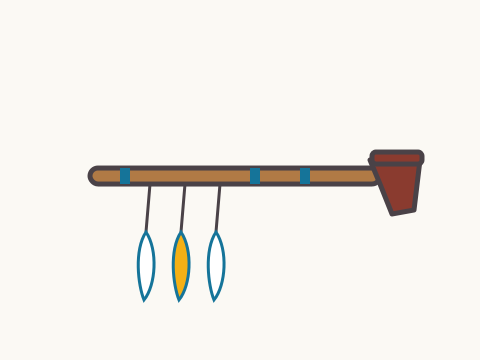
What is called the peace pipe, specialists call the calumet, after the Norman-French word for pipe or pipestem found in early accounts from North America. It means a pipe with a long stem that was and is a sacred object among many Indigenous peoples of North America.
According to The Canadian Encyclopedia, among the peoples of the Plains the calumet was part of the medicine bundle and an object of religious symbolism. It stood for the solidarity and power of a community.
This has little to do with tobacco as a pleasure. The smoke was an offering, smoking a prayer. Except in northern and northwestern North America, where tobacco and smoking were introduced by European traders, the pipe was part of religious life among most peoples.
What was the pipe used for?
The pipe sealed alliances, accompanied negotiations and stood for honour and the sacredness of all life. Those who smoked together bound themselves to what had been agreed.
In the pipe ceremony of the Plains the pipe was offered to the four cardinal directions, which stand for basic forces of life. The ceremony followed a set order and was not performed in passing.
There were also pipes for commerce and trade. And The Canadian Encyclopedia notes that the same pipes were smoked as both peace and war pipes. So the pipe was not purely a sign of peace, but an object with which important shared decisions were affirmed.
What were the pipes made of?
Many pipe bowls are carved from pipestone. One of the best known sites is in Pipestone in today’s Minnesota, where the stone has been quarried for a very long time.
The site is protected today as Pipestone National Monument. According to the US National Park Service it is officially affiliated with 23 tribal nations, and Indigenous people still quarry the stone there in the old traditions.
This shows that the pipe is not an object of the past. For many communities it is still part of their religious life.
How did the European image of the pipe come about?
European travellers, traders and missionaries saw the pipe mainly at negotiations and greetings. So the idea took hold in Europe that it was a sign of peace, and the word peace pipe was born.
This picture simplifies a great deal. It overlooks the religious meaning, the differences between peoples and the fact that the same pipes were also smoked before a war.
The image lives on in the German idiom of smoking the peace pipe with someone, meaning to make up after a quarrel. As an idiom that is harmless; as a description of Indigenous cultures it is not accurate.
How do you speak about the pipe with respect?
For many Indigenous communities the pipe is a sacred object. Using it as part of a costume, as decoration or as a joke hurts that meaning, even when it is meant kindly.
Respect above all means being precise: speaking of the calumet or the ceremonial pipe, naming the peoples where possible and not passing off the cliché as knowledge.
As a symbol of peace the pipe should therefore be used with care. The idiom may stay; but anyone speaking about peace between peoples is better served by the dove, the olive branch or the flag, signs meant for everyone.
What does a calumet look like?
Calumet means the entire pipe, bowl and stem, not merely the stem. The shafts are often long, made of light wood, painted in different colours and adorned with quills, beads, fur and feathers.
The bowls are typically carved from stone or catlinite, a red clay stone, and engraved with geometric designs, adorned with bone and stone inlay or simply polished. A pipe stem covered with the skin of an eagle was acquired by Paul Kane in 1846 from a Cree chief.
Since when has the Pipestone quarry been protected?
According to the US National Park Service, the painter George Catlin made the quarries famous among Euro-Americans in the 1830s. In the 1850s the US government made them a reservation, and in 1937 President Franklin D. Roosevelt signed the legislation making them a national monument.
Indigenous people still quarry and carve pipestone there today. The National Park Service therefore calls Pipestone one of the few sites in its system that preserve a living tradition.
The Canadian Encyclopedia, entry Calumet
There were calumets for commerce and trade, and they were smoked as both peace and war pipes.
Sources
Milestones of the sign
- before colonisationAmong many peoples of North America smoking the pipe is a central part of religious life.
- colonial eraEarly French accounts call the pipe calumet, after the Norman-French word for pipe or pipestem.
- todayAt the quarry in Pipestone, Minnesota, Indigenous people still quarry pipestone in the old tradition.
More peace symbols
- Olive branchPeace, reconciliation, an outstretched handA branch of the olive tree that has stood for the end of a danger since the story of the flood and today frames the world map of the United Nations
- Peace flagPeace, nonviolenceSeven stripes in the colours of the rainbow, violet on top: sewn for a peace march in Italy in 1961, today on balconies and at demonstrations in many countries
Frequently asked questions about the pipe
What was smoked in the pipe?
According to The Canadian Encyclopedia, among many Eastern Woodland groups the pipe was used to burn tobacco as an offering. The smoke was not for pleasure but part of the prayer.
In northern and northwestern North America, tobacco and smoking only arrived with European traders. Among most other peoples, by contrast, pipe smoking was central to religious thought and practice.
What is the pipe called in English and by specialists?
Specialists speak of the calumet. The word comes from the Norman-French term for pipe or pipestem and appears in early historical records from North America.
In English the pipe is usually called the peace pipe. The Canadian Encyclopedia uses that phrase too, but describes at length that the calumet was much more than a sign of peace.
Is the pipe still used today?
Yes. According to The Canadian Encyclopedia, smoking the pipe together, accompanied by prayer, is still the traditional way of marking the beginning of talks between groups or nations and of sealing friendships.
The stone is still quarried too. At Pipestone National Monument in Minnesota, according to the US National Park Service, Indigenous people keep ancient quarrying traditions alive.
For many communities the calumet is therefore not an exhibit but an object of prayer. Anyone invited to a ceremony follows the rules of the hosts.
How old are the traces?
At the Pipestone quarry, according to the National Park Service, archaeologists have found evidence of more than 3,000 years of human activity. Numerous tribes connect the site with their history in oral traditions, and European visitors have written about it since the 17th century.
Individual pipes can be dated too. The Canadian Encyclopedia shows a decorated Iroquoian clay pipe found in Montréal that has been carbon dated to between 1475 and 1525. Pipes in northeastern North America were thus already finely decorated in the 15th century.
How does the German dictionary explain the word?
The German dictionary DWDS gives two meanings. The first, often historical, describes a smoking implement in some non-European cultures whose shared use sealed a peace between hostile parties.
The second is colloquial and often jocular: an object or an act seen as a sign of goodwill and of the wish to settle a conflict. Both meanings show the European view; the religious side of the calumet does not appear in them.
What else was prayed for with the pipe?
The Canadian Encyclopedia describes the calumet as associated with thunder and as signifying honour and the sacredness of all life. It was used to ratify alliances, to bring needed rain and to attest contracts and treaties.
The pipe was therefore an object for many situations in the life of a community, for the weather as much as for relations with other groups. The image of a pure peace pipe captures only a small part of this.
From a sign to a mission of your own
A symbol says what someone stands for. What comes of it is decided where people start something together: in a neighbourhood, a school, a club. On W3ltfrieden you will find missions where exactly that happens.
Find your peace mission