Peace symbols
Peace flag
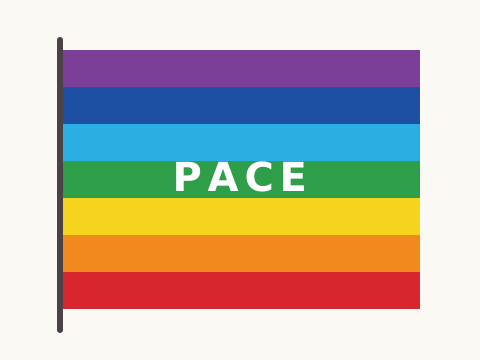
Seven stripes in the colours of the rainbow, violet on top: sewn for a peace march in Italy in 1961, today on balconies and at demonstrations in many countries
Key points at a glance
- The peace flag has seven stripes in the colours of the rainbow, violet at the top, and usually the word PACE.
- Aldo Capitini had it sewn for the first peace march from Perugia to Assisi on 24 September 1961.
- Its models were colourful flags of the Italian peace movement of the 1950s and a World Peace Flag from 1912.
- The rainbow flag of the Pride movement is a different flag: red at the top, designed in 1978.
In numbers
1961
first flag
at the march on 24 September
7
stripes
violet on top, red at the bottom
1
surviving original
kept in Perugia
Peace flag
- Created
- 1961 in Perugia
- Designed by
- Aldo Capitini with women of the committee
- Stripes
- seven
- Top colour
- violet
Pride flag
- Created
- 1978 in San Francisco
- Designed by
- Gilbert Baker
- Stripes
- first eight, today usually six
- Top colour
- red
Documented
- For the first march from Perugia to Assisi on 24 September 1961, Aldo Capitini had a flag of seven stripes sewn, with violet on top.
- As early as the 1950s, the labour movement and the Partisans of Peace carried colourful flags on their marches.
- The only surviving copy is kept in the San Matteo degli Armeni library in Perugia.
Open
- No reference to the flag has yet turned up in Capitini’s papers on the 1961 march.
- Whether colourful flags were already seen at the 1949 congress in Paris is not documented.
- Sapereambiente considers it likely that the flag goes back to James Van Kirk’s world peace flag.
- Whether Capitini had the Flood in mind with the rainbow is not documented.
- Origin
- Italy, peace march from Perugia to Assisi
- Recorded since
- 24 September 1961
- Creator
- Aldo Capitini, philosopher and peace activist
- Stands for today
- Peace, nonviolence
- Author
- Johannes Max Harms
What does the peace flag look like?
The peace flag has seven horizontal stripes in the colours of the rainbow. Violet is on top, followed by blue, light blue, green, yellow, orange and red at the bottom. In its common form the Italian word PACE, peace, stands in white letters in the middle.
That makes it recognisable from a distance: many colours, violet on top, a word in the middle. There are versions in other languages, for example with PEACE or FRIEDEN, but the Italian one is the best known.
The flag has no owner and no binding rule for size or shades. It is used by groups of very different backgrounds, from parishes to political initiatives.
Where does this flag come from?
The peace flag comes from Italy. For the first peace march from Perugia to Assisi on 24 September 1961, the philosopher Aldo Capitini, founder of the Italian nonviolence movement, had friends sew a flag of seven coloured stripes, with violet on top.
The idea was not entirely new. According to the Fondazione Imago Mundi, the labour movement and the Peace Partisans were already carrying multicoloured flags on their marches in the 1950s. Another model was a World Peace Flag of seven colours with the earth in the middle.
The only surviving example of Capitini’s flags is kept today in Perugia, in the San Matteo degli Armeni library, which specialises in peace, nonviolence and human rights.
What does Assisi have to do with the flag?
Assisi is the town of Saint Francis, who stands for nonviolence and peace in Italy. Capitini chose it as the destination of his march, which began in Perugia.
Capitini is regarded as the one who invented the peace march as a form in Italy. The rainbow flag has been part of it since the very first time.
So the flag was not created in a studio like the peace sign, but on the street, sewn for a particular day. That it is still in use today it owes to the people who kept bringing it along.
How does it differ from the rainbow flag of the Pride movement?
Both flags use the colours of the rainbow, but they have different origins and meanings. The peace flag dates from 1961, has seven stripes and starts with violet on top. The rainbow flag of the queer movement was designed by Gilbert Baker in San Francisco in 1978; it starts with red on top and today usually has six stripes.
The easiest way to tell them apart is the top colour and the lettering. If violet is on top and PACE is in the middle, it is the peace flag.
Mix-ups happen because both flags are often seen at the same demonstrations. Anyone who wants to hang up a flag should therefore know which one they mean.
What does the flag stand for today?
The flag stands for peace and nonviolence, for the wish to resolve conflicts without war. It is carried at demonstrations and hung from balconies and windows, as a quiet sign from the people who live there.
The rainbow itself has an old meaning. In the story of the flood God sets it in the clouds after the flood as the sign of a covenant. How far Capitini had this in mind is not documented, but the connection is often made.
As with every sign: the flag shows an attitude, it does not prove one. What it means is decided by what the people who hang it up do.
What were the flag’s forerunners?
As early as 1912 the Methodist pastor James Van Kirk of Youngstown, Ohio, designed a World Peace Flag of seven colours with the earth against a starry sky. According to Sapereambiente, the 20th peace conference in The Hague adopted this flag in 1913.
In Italy in the 1950s the Peace Partisans, a movement close to the labour movement, carried flags made of many colourful strips of cloth. A photo from 1951 taken in Potenza Picena shows such a flag with a dove and the words “W la pace”, long live peace.
Sapereambiente therefore considers it likely that the rainbow flag grew out of Van Kirk’s flag and that Capitini took the idea from the Peace Partisans. His achievement was to give the flag its present form, with violet at the top.
What is still open about its history?
The flag’s origin is not fully settled. Sapereambiente points out that no reference to the flag has so far emerged in Capitini’s papers on organising the 1961 march, although he paid close attention to how it looked and checked the placards carefully, for example.
The magazine also considers it likely that colourful flags were already seen in 1949 at the first congress of the Peace Partisans in Paris, together with Picasso’s dove, and points to the poster of the 1952 congress in Vienna with a dove above a rainbow. This is not proven; according to the magazine, a search of the archives could confirm it.
What is certain is that Capitini’s flag of 1961 shaped the form that has been recognised as the peace flag ever since.
Fondazione Imago Mundi on the first peace flag
Since then these seven coloured stripes, which trace the colour spectrum of the rainbow, have been recognised as the universal symbol of peace.
Sources
- Fondazione Imago Mundi: First peace flag
- Sapereambiente: Com’è nata la bandiera della pace?
- Luther Bible 2017: Genesis 9
- Yale Law School, Avalon Project: Hague Convention IV and Regulations, 1907
- United Nations: UN Emblem and Flag
- Protestant Church in the Rhineland, peace education: Die Pace-Fahne weltweit
Milestones of the sign
- 1950sIn Italy the labour movement and the Peace Partisans carry multicoloured flags on their marches.
- 24 Sep 1961First peace march from Perugia to Assisi. Aldo Capitini has a flag of seven stripes sewn for it.
- todayThe only surviving example of these first flags is kept in the San Matteo degli Armeni library in Perugia.
More peace symbols
- Peace signPeace, disarmament, protest against warA circle, one vertical line and two slanted ones: designed in 1958 for a march against nuclear weapons, today the best known peace sign in the world
- Dove of peacePeace, reconciliation, hopeA white dove, often with a branch in its beak: an image from the story of the flood that Pablo Picasso turned into the sign of a worldwide movement in 1949
Frequently asked questions about the flag
Who sewed the first flag?
According to the Fondazione Imago Mundi, Capitini defined its present appearance together with Maria Francesca Siciliani, the young daughter of friends of his. She bought the cloth and sewed it together with the other women of the committee.
At the end of the march Capitini gave the flag to the girl. This one is the only surviving example of those first flags and is kept in Perugia today.
Is there an official flag for peace?
No. No authority and no organisation lays down what a peace flag must look like. The rainbow flag with PACE is the most widespread, but it has neither an owner nor a specification.
The blue flag of the United Nations with its olive branches stands for an organisation, not a movement. According to the United Nations, it identifies the Organization’s work in areas of trouble and conflict to all parties concerned.
What does a white flag mean?
The white flag is a different sign with a legal meaning. Under Article 32 of the Hague Regulations of 1907, a parlementaire is a person authorised by one party to a war to communicate with the other, who advances bearing a white flag. He is inviolable, and so are those who accompany him.
The white flag therefore says: we want to talk. The rainbow flag says: we want peace. In the Unicode character set the white flag has its own place as U+1F3F3 WAVING WHITE FLAG.
Does the flag come from the British movement against nuclear weapons?
That is often said, but it cannot be shown. According to a common reading, Capitini took the idea from the marches to Aldermaston, where the British Campaign for Nuclear Disarmament demonstrated from 1958.
According to Sapereambiente, the campaign has confirmed that no rainbow flags were seen on the early Aldermaston marches. That is where the sign in the circle designed by Gerald Holtom first appeared. The flag’s roots lie rather in Italy itself.
What does the word PACE mean?
PACE is the Italian word for peace. The flag carries an Italian word because it comes from the Italian movement for nonviolence. The Protestant Church in the Rhineland describes the Pace flag in its peace education material as a sign of peace all over the world.
There it links the flag with the rainbow from the story of the flood, which God sets as a sign after the waters. This reading is common, although there is no evidence that Capitini himself had it in mind.
From a sign to a mission of your own
A symbol says what someone stands for. What comes of it is decided where people start something together: in a neighbourhood, a school, a club. On W3ltfrieden you will find missions where exactly that happens.
Find your peace mission