Peace symbols
Peace sign
A circle, one vertical line and two slanted ones: designed in 1958 for a march against nuclear weapons, today the best known peace sign in the world
Key points at a glance
- The British designer Gerald Holtom drew the sign on 21 February 1958 for the Campaign for Nuclear Disarmament.
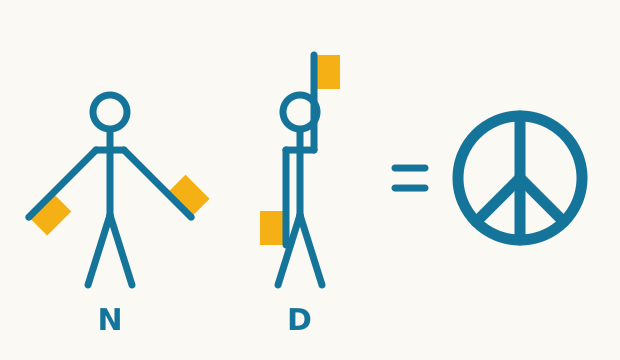
- It lays the semaphore letters N and D on top of each other, for Nuclear Disarmament.
- Holtom deliberately left it unprotected; anyone may use it freely.
- The reading as a “death rune” comes from the Nazi era and has nothing to do with the design.
- The two-finger gesture is a separate sign from the Second World War.
In numbers
1958
designed
on 21 February, by Gerald Holtom
500
placards at its first appearance
Easter 1958 in London
0
protective rights
Holtom deliberately left it free
The original
- A circle with a vertical line running right through the middle.
- Two lines pointing diagonally down from the centre, like the arms for N in semaphore.
- No version with the lines pointing up: that one is not Holtom’s.
- In the Unicode character set it is U+262E PEACE SYMBOL.
- The hand with two spread fingers is a separate sign from 1941, in Unicode U+270C.
- black on white, for Good Friday and Saturday250
- white on green, for Easter Sunday and Easter Monday250
- Origin
- Great Britain, Campaign for Nuclear Disarmament (CND)
- Recorded since
- 21 February 1958
- Creator
- Gerald Holtom, designer (1914 to 1985)
- Stands for today
- Peace, disarmament, protest against war
- Author
- Johannes Max Harms
What does the peace sign mean?
The peace sign consists of a circle, a vertical line and two lines running diagonally down from the centre. It was not designed as a general sign of peace but for a specific purpose: the British Campaign for Nuclear Disarmament, CND for short. In Britain it is still recognised above all as that campaign’s sign.
In the rest of the world it is understood more broadly, as a sign of peace as such. That is how CND itself describes it: in Britain it stands for nuclear disarmament, elsewhere it is simply known as the peace symbol. Anyone who paints it on a placard today usually means this general sense.
There is a simple reason it could spread so widely. According to the German Patent and Trade Mark Office, Holtom deliberately chose not to protect his design so that anyone could use it freely. The sign belongs to no one.
Who designed the sign?
The British designer Gerald Holtom designed the sign on 21 February 1958. He had studied at the Royal College of Art in London and was a conscientious objector during the Second World War, working on a farm in Norfolk instead.
The occasion was a planned protest march from London to Aldermaston, where British nuclear weapons were developed. Holtom showed his sketches to a small group in the office of the newspaper Peace News and to the committee preparing the march. There it was decided to use the sign.
At first Holtom had thought of a Christian cross in a circle. Several priests he asked, however, did not want to see the cross on a protest march. His sketches are kept today by the University of Bradford in the Commonweal Collection.
How is the sign made from N and D?
Holtom explained that the sign combines two letters of the semaphore alphabet, which sailors use to signal with flags. For N both arms point diagonally down, for D one arm points up and one down. Lay the two figures over each other and draw a circle around them, and you have the peace sign. N and D stand for Nuclear Disarmament.
In a letter to Hugh Brock, the editor of Peace News, Holtom later gave a more personal explanation. He had drawn himself, in despair, with his hands stretched downwards like the peasant before the firing squad in a painting by Goya, and turned it into a line with a circle around it. Both readings come from him.
Invented origins also circulate. The German Patent and Trade Mark Office notes that the claim that it is a Germanic "death rune" goes back to a reinterpretation from the Nazi era and has nothing to do with Holtom’s design.
How did the sign become known worldwide?
It was first seen in public at Easter 1958 on the march to Aldermaston, on 500 round cardboard placards on sticks. Half were black on white, the other half white on green. The colours were meant to change like the church’s colours at Easter, from winter to spring, from death to life.
The first badges were made by Eric Austin of Kensington from white clay, with the sign painted in black. This too was deliberate: fired clay, the accompanying note explained, would be among the few things to survive a nuclear war.
From Britain the sign travelled into other movements. According to the German Patent and Trade Mark Office it was taken up by the civil rights activists around Martin Luther King, later by the student movement, and the protests against the Vietnam War made it world famous. In apartheid South Africa the government tried to ban it.
What does the two-finger gesture mean?
The peace sign made with the hand is a sign of its own with its own history. Index and middle finger form a V, the other fingers are folded in. All it shares with the symbol in the circle is that both can stand for peace today.
The V comes from the Second World War. In January 1941 the Belgian politician Victor de Laveleye called on people in occupied Belgium over the radio to paint a V on walls as a sign of resistance, for the French victoire, victory, and the Flemish vrijheid, freedom. Winston Churchill made the two-finger gesture famous.
Later the same gesture became a greeting of the peace movement. What it means therefore depends on the context: peace, victory, agreement or simply a friendly greeting in a photo.
Gerald Holtom in a letter to Hugh Brock, editor of Peace News
I was in despair. Deep despair. I drew myself: the representative of an individual in despair, with hands palm outstretched outwards and downwards in the manner of Goya’s peasant before the firing squad. I formalised the drawing into a line and put a circle around it.
Sources
Milestones of the sign
- 21 Feb 1958Gerald Holtom designs the sign for the British Campaign for Nuclear Disarmament.
- Easter 1958First public appearance on 500 round cardboard placards on the march from London to Aldermaston.
- soon afterThe first badges are made from fired white clay, painted with the black sign.
- laterThe civil rights movement in the USA and the student movement take up the sign.
- Vietnam WarWith the protests against the Vietnam War it becomes known worldwide.
More peace symbols
- Dove of peacePeace, reconciliation, hopeA white dove, often with a branch in its beak: an image from the story of the flood that Pablo Picasso turned into the sign of a worldwide movement in 1949
- Peace flagPeace, nonviolenceSeven stripes in the colours of the rainbow, violet on top: sewn for a peace march in Italy in 1961, today on balconies and at demonstrations in many countries
Frequently asked questions about this sign
What does the upside-down sign mean?
Holtom’s design has a fixed orientation: the vertical line runs through the circle and the two slanted lines point downwards, like the arms of the N in semaphore. A version with the lines pointing up is not a second version by him, simply a sign turned around.
Those who give it a meaning of its own usually point to a supposed “death rune”. The German Patent and Trade Mark Office explains that this reading comes from the Nazi era: the Algiz rune was then reinterpreted as a “life rune” and, turned over, counted as a “death rune”. Völkisch esotericists had only invented that meaning at the start of the 20th century; it has nothing to do with the historical runic alphabets.
May the sign be used freely?
Yes. According to the German Patent and Trade Mark Office, Holtom deliberately chose not to protect his design so that it would stay free for everyone. The Campaign for Nuclear Disarmament adds that the sign has never been copyrighted; no one has to pay or seek permission.
That has a downside. The sign also appears in advertising and fashion and in contexts the campaign dislikes. In its own words it has no intention of stopping this and only asks commercial users for voluntary support of its education work.
How do you type the sign on a computer?
The sign has its own place in the international character set Unicode: U+262E, named PEACE SYMBOL. The German Patent and Trade Mark Office points this out as well. Because it is an ordinary character, it can be inserted wherever Unicode text is possible, for example through a device’s character or emoji picker or by copying it.
The two-finger gesture is a different character with its own number, U+270C VICTORY HAND. If you explicitly mean the sign in the circle in a message, do not pick the hand.
Are there variations of the sign?
Yes, many, and some come from the campaign itself. According to its account, Christian CND extended the vertical line upwards to form a cross. CND Cymru added a daffodil, Scottish CND a thistle, and for a sponsored walk the sign was given little legs.
Holtom had first considered a Christian cross within a circle, but dropped the idea because priests did not want to see the cross on a protest march. Whether he would have approved of the more light-hearted versions, the campaign itself doubts.
Where can the sign be seen today?
The campaign calls it a shorthand for peace and hope. According to its account it has recently been seen in refugee camps, at climate change protests and at its own demonstrations against nuclear weapons, and in 2022 even at the top of the Pyramid Stage at Glastonbury Festival.
The campaign still makes badges with the sign today. Eric Austin of Kensington fired the first ones from white clay in 1958, because fired pottery would be among the few things to survive a nuclear war.
What does the sign have to do with the Easter marches?
The march for which Holtom designed the sign took place over Easter 1958. According to the German Patent and Trade Mark Office, the sign was first shown in public on Good Friday in Trafalgar Square in London, and with this march the campaign started the tradition of Easter marches.
The colours followed the festival too. According to the campaign, black on white was displayed on Good Friday and Saturday, white on green on Easter Sunday and Monday, just as the church’s liturgical colours change over Easter.
From a sign to a mission of your own
A symbol says what someone stands for. What comes of it is decided where people start something together: in a neighbourhood, a school, a club. On W3ltfrieden you will find missions where exactly that happens.
Find your peace mission