People
Willy Brandt
The chancellor who used talks, treaties and a silent gesture in Warsaw to seek détente between East and West and reconciliation with Germany’s eastern neighbours
In numbers
1971
Nobel Peace Prize
for opening the way to dialogue between East and West
1969
Federal Chancellor
until 1974, the first Social Democrat in the office
1970
Kneeling in Warsaw
on 7 December, the day of the Treaty of Warsaw
- Lifespan
- 18 December 1913 to 8 October 1992
- Origin
- Lübeck, Germany
- Role
- Governing Mayor of Berlin, Federal Chancellor from 1969 to 1974
- Award
- Nobel Peace Prize 1971
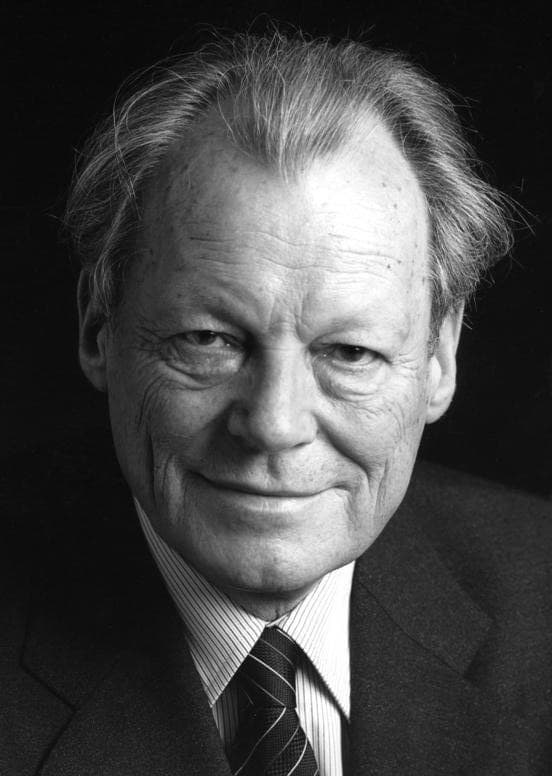
Who was Willy Brandt?
Willy Brandt was a German politician of the SPD, Governing Mayor of Berlin from 1957 to 1966 and Chancellor of the Federal Republic of Germany from 1969 to 1974. With his “New Ostpolitik” he set a course of détente and reconciliation with the states of the Warsaw Pact. For this he received the Nobel Peace Prize in 1971. The Nobel Committee honoured him for paving the way for a meaningful dialogue between East and West.
He was born in Lübeck on 18 December 1913 as Herbert Ernst Karl Frahm. He grew up with his grandfather, a worker and SPD member, and was already active in the Socialist Workers’ Youth as a schoolboy. In 1933 he fled Nazi persecution via Denmark to Norway and from then on called himself Willy Brandt. In 1938 the Nazis stripped him of his citizenship, and after the German occupation of Norway in 1940 he went to Stockholm, where he worked as a journalist.
After the war he reported from Germany as a correspondent for Scandinavian newspapers, including on the Nuremberg trials. In 1948 he regained German citizenship and from then on used the name Brandt as his official name. During the Berlin Blockade he worked closely with Governing Mayor Ernst Reuter, and in 1957 he took over that office himself. He was chairman of the SPD from 1964 to 1987, and from 1966 to 1969 Foreign Minister and Vice-Chancellor in the Grand Coalition.
After the 1969 federal election he became Chancellor of a coalition of the SPD and FDP, with Walter Scheel as Foreign Minister. In May 1974 he resigned after the East German spy Günter Guillaume was exposed in his circle. Afterwards he was President of the Socialist International until 1992 and from 1977 chaired the North-South Commission, which dealt with questions of international development. He died on 8 October 1992 in Unkel near Bonn.
What did Willy Brandt stand for?
He stood for the principle that war must no longer be a means of politics and that peace should be secured through détente, renunciation of force and talks across the bloc divide. This conviction grew in Berlin, at the intersection of the East-West conflict. After the failed popular uprisings in Eastern Europe he concluded that communist rule could not be removed by force without risking nuclear war. The West, he believed, could only bring about change in the long run through détente, “peaceful coexistence” and exchange between the blocs.
After the Wall was built in 1961, he pursued a “policy of small steps” as Governing Mayor, meant to ease the lives of people in divided Berlin. His closest adviser Egon Bahr coined the formula “change through rapprochement” for it in 1963. The first negotiations with the East German government led to the first border pass agreement, which allowed hundreds of thousands of West Berliners to visit relatives in the eastern part of the city over Christmas 1963/64. Instead of grand speeches about reunification, the aim was tangible relief for separated families.
A second principle was reconciliation with Germany’s eastern neighbours. He was convinced that reconciliation with Poland would only be possible if Germany no longer questioned the border along the Oder and Neisse rivers. As Foreign Minister he spoke out for the first time in 1968 in favour of respecting this border, but could not prevail within the Grand Coalition. At the same time he held on to the goal of German unity and to the right of the Germans to self-determination.
In his Nobel Lecture of 1971 he placed this policy in a longer line of German history. He recalled Gustav Stresemann, who had fought for understanding with France after the First World War, and Carl von Ossietzky, who received the Nobel Peace Prize for 1935 as a prisoner. As a young exile in Norway, Brandt had himself taken part in the campaign for that prize. He did not see peace as the mere absence of war, but as a permanent task that also includes justice between nations.
From his Nobel Lecture “Peace Policy in Our Time” in Oslo on 11 December 1971, delivered in German, in the English translation published by NobelPrize.org.
War must not be a means to achieve political ends. Wars must be eliminated, not merely limited.
What did Willy Brandt achieve for peace?
He brought the Federal Republic to reorder its relations with the Soviet Union, Poland, East Germany and Czechoslovakia by treaty and to renounce the use of force in doing so. The Treaty of Moscow was signed on 12 August 1970, the Treaty of Warsaw on 7 December 1970. The Basic Treaty with East Germany followed in December 1972 and the Treaty of Prague with Czechoslovakia in December 1973. With these, the Federal Republic accepted the Oder-Neisse line as Poland’s western border and the loss of the former German eastern territories as a result of the Second World War.
The best-known image of this policy was taken on the day of the Treaty of Warsaw. At the memorial to the victims of the Warsaw Ghetto Uprising, Brandt laid a wreath and knelt down during the minute of silence. The Federal Chancellor Willy Brandt Foundation describes the kneeling as an acknowledgement of German guilt and responsibility for the crimes of the Nazi regime committed against millions. The American news magazine “Time” named him Man of the Year for 1970.
The treaties also changed the everyday lives of many people. Arrangements for travel, visits and post between the two German states brought relief to millions of Germans. According to NobelPrize.org, the eastern treaties also laid the foundations for the Four Power Agreement on Berlin, which made it easier for families from both parts of the city to visit each other. His government also signed the Treaty on the Non-Proliferation of Nuclear Weapons.
Internationally, this policy earned the Federal Republic the standing of a partner committed to peace, without calling its anchoring in the Western alliance into question. Ostpolitik helped to reduce tensions between the blocs and in 1973 entered a multilateral phase. Its high point was the Helsinki Final Act of 1975, in which 35 states committed themselves to the inviolability of borders and respect for human rights. He stayed with these themes after his chancellorship, for example with the 1980 report of the North-South Commission, published in German as “Das Überleben sichern”.
What criticism is there of Willy Brandt?
Ostpolitik was fiercely contested at home, above all the recognition of the Oder-Neisse line. For many expellees it meant the final loss of their homeland, and the expellee associations fought the eastern treaties just as the CDU and CSU opposition did. In the Bundestag the treaties remained the subject of hard disputes. Brandt himself had concluded from his years in Berlin that invoking legal positions which could not become reality was merely impotence disguised by words; this is how he described it in his Nobel Lecture.
The dispute reached into his own coalition. Because of Ostpolitik, several members of parliament from the SPD and FDP left the government camp, and in April 1972 a constructive vote of no confidence by the CDU/CSU against him failed. In September 1972 he called a vote of confidence with the aim of losing it and thereby bringing about new elections. Constitutional lawyers criticised this approach because a deliberately lost vote of confidence was not provided for in the Basic Law.
Another point of criticism concerns his attitude towards the civil rights movements in Eastern Europe in the 1980s. So as not to endanger his relations with those in power, he avoided publicly taking sides with dissidents. That he reacted relatively moderately to the imposition of martial law in Poland in 1981 and did not meet Solidarność leader Lech Wałęsa during his visit to Poland in 1985 drew considerable criticism, according to the Federal Chancellor Willy Brandt Foundation. The agreements the SPD negotiated with the East German SED during this period were also highly controversial.
His chancellorship ended with a spy affair. In Günter Guillaume, an East German spy had worked in his circle and gained insight into private matters as well. In May 1974, a year and a half after the election victory of November 1972, Brandt took political responsibility and resigned. In his letter of resignation he spoke of negligence and stressed that a chancellor must not be open to blackmail.
From the same Nobel Lecture, in which he called a policy for peace the genuine Realpolitik of the age.
War is no longer the ultima ratio but rather the ultima irratio.
What remains of Willy Brandt?
What remains above all is the idea that peace has to be actively shaped and can begin with talks, even when positions are far apart. Ostpolitik reduced tensions in the Cold War and kept connections alive between people in East and West. The Federal Chancellor Willy Brandt Foundation sees in it important preconditions for the end of the Cold War and for overcoming the division of Germany and Europe. This assessment stands alongside the critical voices on his policy that still exist today.
The kneeling in Warsaw remains one of the best-known images of German post-war history. It shows that a gesture without words can sometimes say more than a speech. The Living Museum Online describes it as a silent plea for forgiveness by a representative of the “other” Germany for the crimes committed by Germans and in Germany’s name. Brandt himself had spent the Nazi years as a persecuted exile.
On 10 November 1989, the day after the fall of the Wall, he spoke in front of Schöneberg Town Hall in West Berlin, where he had lived through the years of division as Governing Mayor. In December 1990 he opened the first session of the all-German Bundestag in the Reichstag building as its oldest member. In 1991 the Bundestag voted 338 to 320 on his motion for Berlin as the seat of government. After his death in 1992 he was honoured there with a state ceremony.
His Nobel Lecture links him with two earlier German laureates. Gustav Stresemann stands for the Weimar Republic’s attempt to build trust with France after the First World War, Carl von Ossietzky for the courage to write against militarism and nationalism, even at the cost of his own life. In 1971 Brandt thanked the Nobel Committee “in the name of free Germany” for choosing Ossietzky. Read side by side, the three lives show how differently people in Germany stood up for peace in the twentieth century.
Also from the Nobel Lecture of 11 December 1971, in the NobelPrize.org translation.
Peace policy is a sober task.
Frequently asked questions
- When and where did Willy Brandt live?
- Willy Brandt was born in Lübeck, Germany, and lived from 18 December 1913 to 8 October 1992.
- Why did Willy Brandt receive the Nobel Peace Prize?
- Willy Brandt received the Nobel Peace Prize in 1971. The Nobel Committee honoured him for paving the way for a meaningful dialogue between East and West.
- What role did Willy Brandt play?
- Willy Brandt was Governing Mayor of Berlin and Federal Chancellor from 1969 to 1974.
Sources
Life
- 1933Flees Nazi persecution to Norway. Herbert Frahm calls himself Willy Brandt from then on.
- 1957Elected Governing Mayor of Berlin. After the Wall is built in 1961, he pursues a “policy of small steps”.
- 1969Becomes Federal Chancellor of a coalition of the SPD and FDP. The government begins its “New Ostpolitik”.
- 1970Treaty of Moscow in August, Treaty of Warsaw and the kneeling at the Ghetto memorial in December.
- 1971On 10 December he receives the Nobel Peace Prize in Oslo.
- 1974Resigns as Federal Chancellor after the East German spy Günter Guillaume is exposed.
- 1989Speaks in front of Schöneberg Town Hall the day after the fall of the Wall.
More portraits
- Gustav Stresemann10 May 1878 to 3 October 1929The Weimar foreign minister who, after the First World War, chose negotiation over confrontation and secured peace on the Rhine by treaty with France
- Carl von Ossietzky3 October 1889 to 4 May 1938The journalist who exposed secret rearmament in the Weimar Republic, refused to flee and received the Nobel Peace Prize as a prisoner of the Nazis
From role model to a mission of your own
None of these people acted alone. What connects them is the step from concern to action. That step is possible on a small scale too: in a neighbourhood, a school, a club.
Find your peace mission