People
Gustav Stresemann
The Weimar foreign minister who, after the First World War, chose negotiation over confrontation and secured peace on the Rhine by treaty with France
In numbers
1926
Nobel Peace Prize
the first German laureate, shared with Aristide Briand
1925
Locarno Treaties
renunciation of force to change the western borders
1923
Reich Chancellor
from 13 August to 23 November, then Foreign Minister until 1929
- Lifespan
- 10 May 1878 to 3 October 1929
- Origin
- Berlin, Germany
- Role
- Reich Chancellor in 1923, Reich Foreign Minister from 1923 to 1929
- Award
- Nobel Peace Prize 1926, shared with Aristide Briand
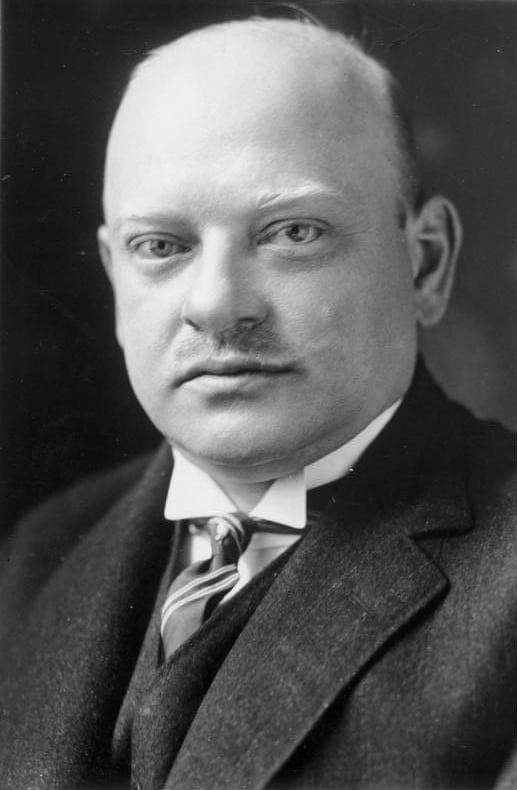
Who was Gustav Stresemann?
Gustav Stresemann was a German politician of the Weimar Republic, Reich Chancellor for just over three months in 1923 and Foreign Minister from 1923 until his death in 1929. He sought understanding with France and helped bring about the Locarno Treaties of 1925, in which Germany, France and Belgium renounced any forcible change to their common borders. For this he received the Nobel Peace Prize in 1926 together with the French Foreign Minister Aristide Briand. He was the first German to be awarded the Nobel Peace Prize.
He was born in Berlin on 10 May 1878, the son of an innkeeper. He studied in Berlin and Leipzig and wrote his doctoral thesis on the bottled beer trade in Berlin. He then worked for business associations in Dresden, joined the National Liberal Party and in 1907 was elected to the Reichstag as its youngest member at the time. Although he represented employers, he supported the idea that management should recognise the right of workers to organise and to bargain collectively.
Shortly after the end of the First World War he founded the right-liberal German People’s Party in 1918 and became its chairman. With this party he was at first critical of the Republic, but he gradually accepted it and argued for broad cooperation ranging from the Social Democrats to the German Nationalists, who were still moderate at the time. In 1919 he was elected to the National Assembly, which drew up a new constitution in Weimar. From 1920 he sat in the new Reichstag, spending the first three years in opposition.
In the crisis year of 1923 he became Reich Chancellor of a grand coalition on 13 August. His government ended passive resistance to the French and Belgian occupation of the Ruhr and began stabilising the currency, which brought hyperinflation to an end. His chancellorship ended on 23 November 1923, but he served as Foreign Minister in the following governments for the rest of his life. He died of a stroke in Berlin on 3 October 1929, and hundreds of thousands lined the streets for his funeral procession a few days later.
What did Gustav Stresemann stand for?
As Foreign Minister he worked for understanding with the victorious powers of the First World War, above all France, in order to lead Germany out of its isolation in foreign affairs. His aim was a revision of the Treaty of Versailles, a goal he shared with practically every politician of the Weimar Republic. Unlike many others, however, he wanted to achieve it through negotiation rather than confrontation. According to the Stresemann Society, he was convinced that the poisonous hatred of other countries could only be overcome through peaceful cooperation with the victors.
This path was not self-evident for him. Before and during the First World War he had called for a strong navy and supported German annexations and unrestricted submarine warfare. According to NobelPrize.org, it was only his realisation in the autumn of 1918 of how poor the military situation really was that changed his view of the world. He began to see states as parts of a web of political and commercial relationships in which a policy of force and conquest ultimately leads to ruin.
One principle of his foreign policy was to take the interests of the other side into account. France wanted to keep Germany weak out of concern for its own security, so he offered to secure the common border by treaty. With a note of 9 February 1925 the German government took the initiative for a security pact to be guaranteed by Great Britain. In return he hoped that the victors would evacuate the occupied Rhineland earlier than the Treaty of Versailles provided.
This also meant Germany’s return to the international community. In September 1926 Germany was admitted to the League of Nations, which had until then been closed to it. In the same year he also reached an understanding with the Soviet Union in the Treaty of Berlin. In his Nobel Lecture of 1927 he called Locarno a policy of understanding and free will which, in contrast to the policies of the past, must become the policy of the future.
From his Nobel Lecture “The New Germany”, delivered in German in Oslo on 29 June 1927, in the English translation published by NobelPrize.org.
The policy of Locarno is incompatible with policies of distrust, violence, and oppression. Locarno is the policy of understanding and free will.
What did Gustav Stresemann achieve for peace?
His most important achievement is the Locarno Treaties, concluded on 16 October 1925. In them Germany, France and Belgium renounced any forcible change to their borders, and Germany confirmed its western border as set out in the Treaty of Versailles as well as the demilitarisation of the Rhineland. Great Britain and Italy guaranteed that they would come to the aid of the injured party if the treaty were violated. Arbitration treaties with France and Belgium as well as with Poland and Czechoslovakia were to bring disputes before an international commission.
The treaties were regarded as a decisive step towards securing peace in Europe because they largely satisfied France’s need for security with regard to Germany. According to the German Historical Museum, the precondition for this was the trusting cooperation between Stresemann and Briand. Both received the Nobel Peace Prize for their work in 1926. With this, Germany finally overcame its isolation in foreign affairs.
His policy also gave Germany economic breathing space. With the Dawes Plan of 1924, reparations were aligned with Germany’s ability to pay, and with the Young Plan of 1929 he achieved a further revision. Almost at the same time it was decided to evacuate the Rhineland as early as 1930, five years earlier than the Treaty of Versailles provided. He did not live to see that evacuation.
In 1928 Germany played a decisive part in bringing about the Kellogg-Briand Pact, in which the participating states outlawed war under international law. According to the Stresemann Society, 63 states joined it, almost the entire world of the time. The renunciation of force that Locarno had laid down for Germany’s western borders thus rested on a much broader foundation. In these years Germany increasingly regained international standing.
What criticism is there of Gustav Stresemann?
The most important criticism concerns the eastern border. At Locarno Germany confirmed only its western border; there was no recognition of the German-Polish border, and Germany expressly kept open the possibility of revising its eastern border. With Poland and Czechoslovakia only arbitration treaties were concluded, with no guarantee of the borders. Understanding in the West and reservation in the East were thus part of the same policy.
His overall aim was not renunciation but revision. The Stresemann Society notes that his negotiations aimed at revising the Treaty of Versailles and that, as a child of his time, he always kept national interests in view. He combined them, however, with the conviction that the interests of others also had to be taken into account. According to this account he was not a politician of European unification in today’s sense, even though towards the end of his life he endorsed first steps towards such integration as a vision.
His stance before 1918 is also viewed critically. During the First World War he advocated a German victorious peace and far-reaching annexations, and in 1916 he supported unrestricted submarine warfare. He helped to bring down the government of Chancellor Bethmann Hollweg, which he considered too moderate, and he opposed the Treaty of Versailles. A rather nostalgic attachment to the German Empire remained with him, although according to the Stresemann Society it never significantly influenced his policy.
At home his policy was fiercely contested. Because successes came only slowly, he constantly had to defend it in public and within his own party. In his Nobel Lecture he himself spoke of distrust abroad and of misrepresentation at home, which had seen weak resignation in an active policy and called it a policy of renunciation. After his death the idea of closer cooperation in Europe found hardly any support in Germany.
From the same Nobel Lecture; Willy Brandt quoted this passage in his own Nobel Lecture in 1971.
Locarno means much more to me. It is the achievement of lasting peace on the Rhine, guaranteed by the formal renunciation of force by the two great neighboring nations and also by the commitment of other states to come to the aid of the victim of an act of aggression in violation of this treaty.
What remains of Gustav Stresemann?
What remains is the experience that even between former enemies trust can grow through treaties, renunciation of force and patient negotiation. The Stresemann Society sees in his example the insight that a state can only prosper if it relies on negotiation rather than military means to pursue its aims. His policy of understanding towards France was exceptional for its time. Giving up maximum demands led to the goal as a foreign policy of small steps.
The peace of Locarno did not last, however. In the course of the Great Depression national egoism came to the fore again, and a few years after his death the Nazis came to power. Willy Brandt said in 1971 that the state of lasting peace of which Stresemann had spoken had been overturned by those who had secretly not renounced force. And yet, Brandt added, the work of Locarno had not been in vain, because it had traced paths that others were able to follow after yet another war.
Franco-German reconciliation after the Second World War was able to build on his policy. The Stresemann Society writes that politicians of a later generation were able to build on it a good twenty years after his death. In his Nobel Lecture Brandt placed him at the start of a line that ran through the Federal Republic’s ties with the West to Ostpolitik. He acknowledged that Stresemann had fought for a policy of understanding against resistance at home and abroad, and he called that civil courage.
Nine years after him, Carl von Ossietzky became another German to receive the Nobel Peace Prize, though as a prisoner of the Nazis. Ossietzky was not a minister but a journalist, and in Brandt’s words he fought militarism and nationalism with a sharp pen. The two lives show two very different ways of standing up for peace in the Weimar Republic: negotiation in office and criticism from outside. Brandt remembered both in Oslo in 1971.
Frequently asked questions
- When and where did Gustav Stresemann live?
- Gustav Stresemann was born in Berlin, Germany, and lived from 10 May 1878 to 3 October 1929.
- Why did Gustav Stresemann receive the Nobel Peace Prize?
- Gustav Stresemann received the Nobel Peace Prize in 1926, shared with the French Foreign Minister Aristide Briand. It honoured their policy of understanding, whose most important result is the Locarno Treaties of 1925.
- What role did Gustav Stresemann play?
- Gustav Stresemann was Reich Chancellor in 1923 and Reich Foreign Minister from 1923 to 1929.
Sources
Life
- 1907Elected to the Reichstag as its youngest member at the time.
- 1918Founds the right-liberal German People’s Party and becomes its chairman.
- 1923Reich Chancellor of a grand coalition. His government ends passive resistance in the Ruhr and begins to stabilise the currency.
- 1925The Locarno Treaties are concluded on 16 October.
- 1926Germany joins the League of Nations in September. Nobel Peace Prize shared with Aristide Briand.
- 1928Germany helps bring about the Kellogg-Briand Pact, which outlaws war.
- 1929Agreement on the Young Plan. On 3 October he dies of a stroke in Berlin.
More portraits
- Willy Brandt18 December 1913 to 8 October 1992The chancellor who used talks, treaties and a silent gesture in Warsaw to seek détente between East and West and reconciliation with Germany’s eastern neighbours
- Carl von Ossietzky3 October 1889 to 4 May 1938The journalist who exposed secret rearmament in the Weimar Republic, refused to flee and received the Nobel Peace Prize as a prisoner of the Nazis
From role model to a mission of your own
None of these people acted alone. What connects them is the step from concern to action. That step is possible on a small scale too: in a neighbourhood, a school, a club.
Find your peace mission