People
Mahatma Gandhi
A lawyer from Porbandar who turned nonviolent resistance into a method for millions and so shaped movements far beyond India
In numbers
21
years in South Africa
where he developed his method of nonviolent resistance
60,000
imprisoned in the salt protest
after the 1930 Salt March against the British salt laws
5
nominations
for the Nobel Peace Prize, which he never received
- Lifespan
- 2 October 1869 to 30 January 1948
- Origin
- Porbandar, India
- Role
- Lawyer and leader of the Indian independence movement
- Award
- No Nobel Peace Prize, despite five nominations between 1937 and 1948
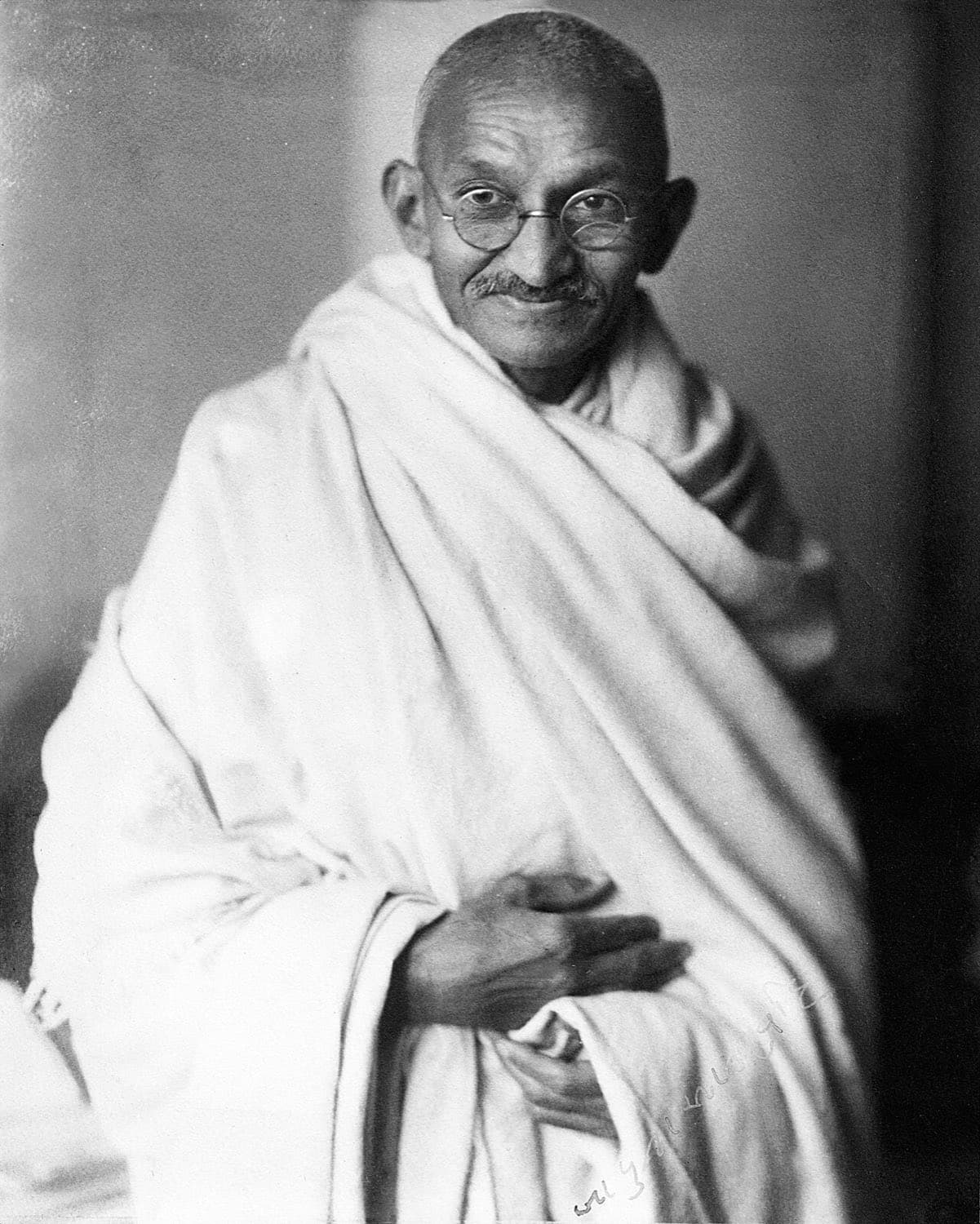
Who was Mahatma Gandhi?
Mahatma Gandhi was an Indian lawyer and political leader who shaped the independence movement against British colonial rule through nonviolent resistance. His full name was Mohandas Karamchand Gandhi, and he was born on 2 October 1869 in Porbandar in western India, where his father was chief minister. “Mahatma” is an honorific that, as the Nobel Foundation explains, means “great-souled”. His mother was a deeply religious Hindu, and the family belonged to a branch of Hinduism in which nonviolence and tolerance between religious groups mattered greatly.
At 18 he went to England to train as a lawyer. On his return he could not find well-paid work in India and in 1893 accepted a contract with an Indian firm in South Africa. A planned single year became 21 years. There he first experienced official racial prejudice and organised the Indian community against laws that discriminated against it.
In 1915 he returned to India, where news of his work in South Africa had already spread. Within a few years he reshaped the Indian National Congress into a mass movement for self-rule. He called for a boycott of British goods and institutions and was arrested several times. In 1922 he was sentenced for sedition and spent two years in prison.
In August 1947 Britain handed over power to two independent states, India and Pakistan. Despite his appeals, partition was accompanied by violence and rioting, and in his final months he worked to end the violence between Hindus and Muslims. On 30 January 1948 he was shot in Delhi on his way to a prayer meeting. He was 78 years old.
What did Mahatma Gandhi stand for?
He stood for Indian self-rule and for achieving it without violence. According to the Nobel Foundation, many Indian nationalists saw nonviolence mainly as a tactic against the British, whereas for him it was a matter of principle. He did not want to defeat the opponent, but to lead him to recognise the injustice of his own laws. This attitude shaped everything he undertook politically.
He called his method satyagraha, which the King Institute at Stanford University translates as “truth-force” or “love-force”. It included public fasting, suspensions of work, boycotts and the deliberate breaking of unjust laws. Those who took part were to accept the punishment openly and not return violence. In this way the injustice was to become visible to everyone.
He was not thinking only of colonial rule. In the early 1930s he fasted in prison against separate electorates for the so-called untouchables, the lowest group in India’s caste system. According to the King Institute, this fast contributed to discrimination against untouchables being outlawed in 1947. Understanding between Hindus and Muslims also remained a concern of his to the very end.
He also rejected segregation outside India. Referring to the situation of African Americans in the United States, he called segregation “a negation of civilisation”. African American visitors such as Howard Thurman in 1935 and Benjamin Mays in 1936 met him in India. In this way his ideas reached the circles from which the American civil rights movement later emerged.
From his weekly paper “Harijan” of 20 July 1935, as documented in the collection “The Mind of Mahatma Gandhi”.
Non-violence is the greatest force at the disposal of mankind. It is mightier than the mightiest weapon of destruction devised by the ingenuity of man.
What did Mahatma Gandhi achieve for peace?
He turned nonviolent resistance into a method with which millions of people could stand up to a colonial power without weapons. The Nobel Foundation calls him the strongest symbol of nonviolence in the 20th century. His campaigns showed that collective refusal can be a political force. India’s independence, which came in 1947, was the goal for which he had built this mass movement.
The best-known example is the Salt March of 1930. With 80 volunteers he walked some 200 miles to the sea and produced salt from seawater there in order to break the British salt laws, which secured the colonial government a tax on the sale of salt. According to the King Institute, more than 60,000 Indians were eventually imprisoned for making salt. After a year he negotiated a truce with Lord Irwin, the representative of the British government.
His greatest influence reached beyond India. Martin Luther King came across his ideas as a student and, according to the King Institute, called Gandhian philosophy the only morally and practically sound method open to oppressed people. In the Nobel Committee’s account, Nelson Mandela was also initially inspired by his nonviolent methods. Both carried his approach into their own struggles against racial segregation.
On 15 June 2007 the United Nations decided to mark his birthday, 2 October, as the International Day of Non-Violence. According to the UN, the resolution reaffirms the universal relevance of the principle of non-violence. The Nobel Committee described the 1989 Peace Prize to the Dalai Lama as in part a tribute to his memory. His contribution was thus recognised even where he himself was never honoured.
What criticism is there of Mahatma Gandhi?
The clearest criticism concerns his early remarks about Black people in South Africa. According to a BBC report, in his early writings he referred to Black South Africans with a racist slur and wrote that Indians were “infinitely superior” to them. At the University of Ghana in Accra, lecturers therefore started a petition in 2016 for the removal of a Gandhi statue. It was taken down in December 2018.
This point was raised during his lifetime. The Nobel Committee’s adviser Jacob Worm-Müller wrote in his 1937 report that his well-known struggle in South Africa had been on behalf of the Indians only, and not of the Black population, whose living conditions were even worse. He honoured him as a person but viewed him more critically as a political leader. He openly questioned whether his ideals were meant to be universal or primarily Indian.
From the peace movement came the objection that he had not been consistently pacifist. According to the Nobel Foundation, critics held that he should have known that some of his campaigns would turn violent, as happened during the Non-Cooperation Campaign in Chauri Chaura, where a crowd attacked a police station and killed many policemen. Others saw him above all as an Indian nationalist. He himself called off campaigns when they turned violent, as early as 1919.
In 1947 the majority of the Nobel Committee decided against him. Shortly before, he had told a prayer meeting that he had always opposed all warfare, but that India would have to go to war against Pakistan if there were no other way of securing justice. Some members saw this as a departure from his rejection of war. After his death the committee made no award in 1948, stating that there was no suitable living candidate; the Nobel Foundation considers it likely that he would have received the prize had he lived one more year.
From his journal “Young India” of 8 October 1925, as documented in the same collection.
I seek entirely to blunt the edge of the tyrant's sword, not by putting up against it a sharper-edged weapon, but by disappointing his expectation that I would be offering physical resistance.
What is Mahatma Gandhi’s legacy?
Above all, his legacy is a method: the organised, nonviolent resistance of many people against laws they consider unjust. He showed that fasting, boycotts and deliberate law-breaking can develop political power when enough people take part. These tools were later taken up in many countries. They still work today without weapons and without a large apparatus.
His influence is especially clear in two people. Martin Luther King adopted his methods for the American civil rights movement and, according to the King Institute, called him the greatest Christian of the modern world, although Gandhi was a Hindu. Nelson Mandela also began his resistance nonviolently in South Africa, the country in which Gandhi had developed his method. A shared question thus links the three: how to end injustice without creating new injustice.
At the same time, his image has become more complex. His early remarks about Black people in South Africa, the doubts of the Nobel Committee and the violence of partition belong to his story as much as his successes. The Nobel Foundation notes that in his lifetime he had many admirers, but also many critics. An honest view of him includes both.
For peace work today, his principle that means and ends must fit together remains. The United Nations sums up his conviction as the belief that just means lead to just ends and that violence is no way to a peaceful society. The International Day of Non-Violence on 2 October recalls this every year. The question of whether conflicts can be resolved without violence has been asked anew ever since.
Frequently asked questions
- When and where did Mahatma Gandhi live?
- Mahatma Gandhi was born in Porbandar, India, and lived from 2 October 1869 to 30 January 1948.
- Did Mahatma Gandhi receive the Nobel Peace Prize?
- No. Mahatma Gandhi was nominated for the Nobel Peace Prize five times between 1937 and 1948, but it was never awarded to him.
- What role did Mahatma Gandhi play?
- Mahatma Gandhi was a lawyer and leader of the Indian independence movement.
Sources
Life
- 1893He goes to Natal in South Africa as a lawyer for an Indian trading company and works there for the Indian minority.
- 1915He returns to India, where his work in South Africa is already known.
- 1919Against the Rowlatt Acts he calls for fasting and a suspension of work. When violence breaks out, he calls off the campaign.
- 1922He is arrested for sedition and spends two years in prison.
- 1930With 80 volunteers he sets out on the Salt March to the sea in order to break the British salt laws on purpose.
- 1947Britain hands over power to two independent states, India and Pakistan. Partition is accompanied by severe violence.
- 1948On 30 January he is assassinated in Delhi on his way to a prayer meeting.
More portraits
- Martin Luther King15 January 1929 to 4 April 1968A pastor from Atlanta who showed that racial segregation could be overcome through boycotts, marches and speeches, without ever turning to violence himself
- Nelson Mandela18 July 1918 to 5 December 2013A lawyer from the Eastern Cape who, after 27 years in prison, governed without revenge and negotiated South Africa’s way out of apartheid into democracy
From role model to a mission of your own
None of these people acted alone. What connects them is the step from concern to action. That step is possible on a small scale too: in a neighbourhood, a school, a club.
Find your peace mission