People
Kofi Annan
The first Secretary-General to rise from the ranks of United Nations staff, who put human rights above state sovereignty and drew lessons from the organisation’s failures
In numbers
2001
Nobel Peace Prize
in two equal portions with the United Nations
7
Secretary-General of the United Nations
the first to emerge from the ranks of UN staff
10
Years in office
two terms from 1 January 1997 to 31 December 2006
- Lifespan
- 8 April 1938 to 18 August 2018
- Origin
- Kumasi, Ghana
- Role
- Seventh Secretary-General of the United Nations
- Award
- Nobel Peace Prize 2001
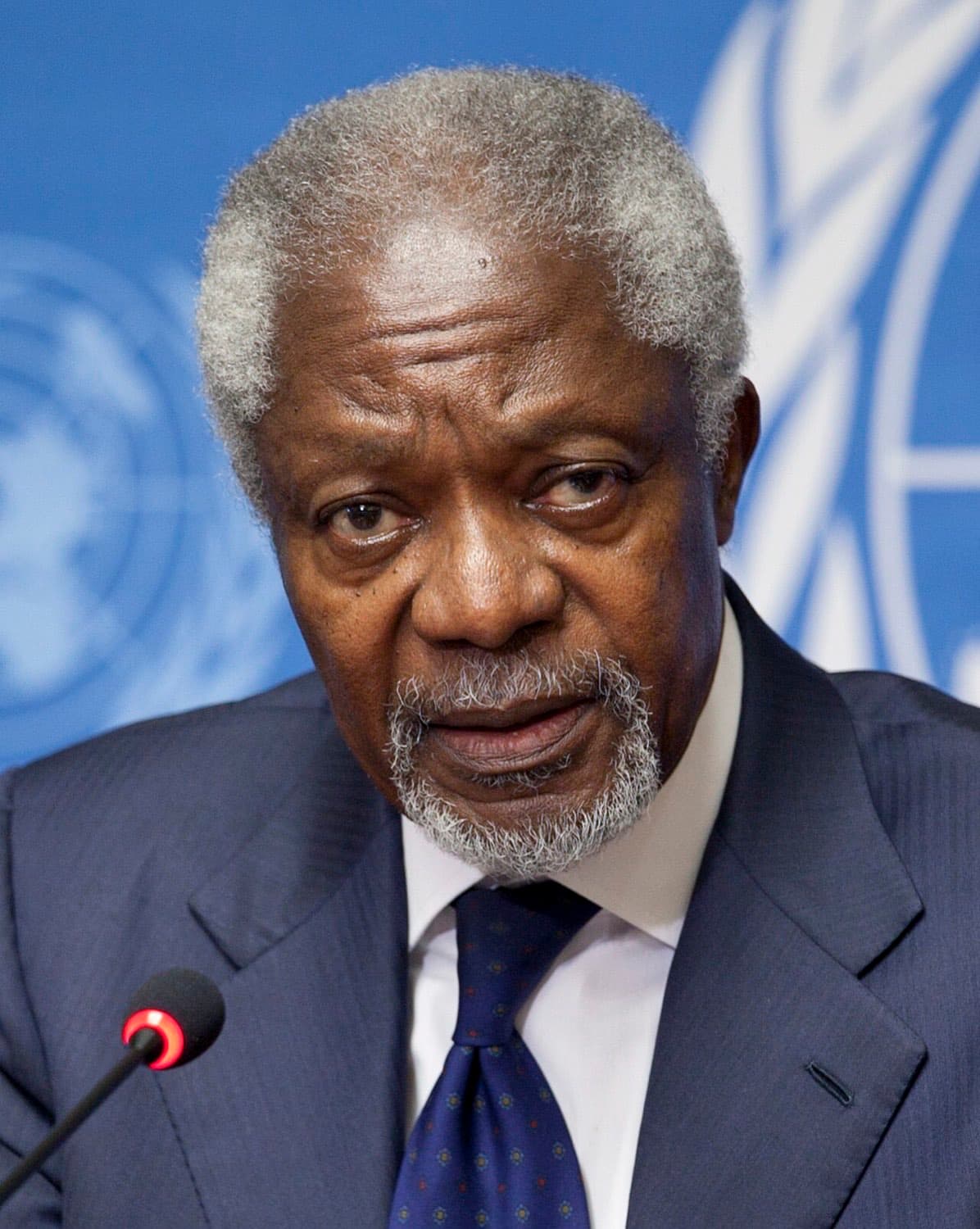
Who was Kofi Annan?
Kofi Annan was Secretary-General of the United Nations from 1997 to 2006 and received the Nobel Peace Prize in 2001 together with the organisation. He was born on 8 April 1938 in Kumasi, in the British colony then called the Gold Coast. His father was a chief and governor of the Ashanti province. Annan died after a short illness in Bern on 18 August 2018.
He attended a Methodist school, Mfantsipim, and graduated in 1957, the year the Gold Coast gained independence and took the name Ghana. He then studied at a technical college in Ghana and continued his education in Switzerland and the United States. In Geneva he attended the Graduate Institute, and in 1972 he completed a degree in management at the Sloan School of the Massachusetts Institute of Technology.
His career with the United Nations began in 1962 as a budget officer at the World Health Organization. He later worked, among other posts, as head of personnel at the Office of the High Commissioner for Refugees in Geneva and became Assistant Secretary-General in 1987. In 1993 he took over the Department of Peacekeeping Operations as Under-Secretary-General. This period includes the genocide in Rwanda and the massacre at Srebrenica, which he later had to confront as Secretary-General.
From 1 January 1997 he led the United Nations as its seventh Secretary-General, serving two terms until the end of 2006. He was the first holder of the office to emerge from the organisation’s own staff. After leaving office he established the Kofi Annan Foundation in Geneva in 2007 and remained in demand as a mediator. Until his death he also chaired The Elders, the group of independent leaders founded by Nelson Mandela.
What did Kofi Annan stand for?
He worked to place the individual human being, not only the state, at the centre of international politics. In his Nobel Lecture he said that throughout his term he had sought to place human beings at the centre of everything the United Nations does, from conflict prevention to development to human rights. Peace, he said, belongs not only to states or peoples but to each and every member of those communities. From this he derived three priorities: eradicating poverty, preventing conflict and promoting democracy.
This stance was especially clear on the question of sovereignty. In 2001 the Nobel Committee stressed that he had made clear that sovereignty cannot be a shield behind which member states conceal their violations. Under his leadership, member states accepted the responsibility to protect in 2005. It holds that the international community must protect people from genocide, war crimes, ethnic cleansing and crimes against humanity when their own state fails to do so.
A second concern was the fight against poverty and disease. Under his leadership, member states agreed on the Millennium Development Goals in 2000, the first global blueprint to end poverty. He played a central role in creating the Global Fund to fight AIDS, Tuberculosis and Malaria. With the Global Compact, launched in 1999, he invited companies to commit to social responsibility.
He believed in bringing everyone to the table, including business, local authorities, civil society and science. The Kofi Annan Foundation recalls this approach with the thought that governments alone cannot shape our future. In his Nobel Lecture he linked this conviction to the image of a girl born that day in Afghanistan. Her fate, he said, is a test of our common humanity and of each person’s responsibility for others.
From his Nobel Lecture in Oslo on 10 December 2001.
Today’s real borders are not between nations, but between powerful and powerless, free and fettered, privileged and humiliated.
What did Kofi Annan achieve for peace?
He renewed the United Nations after the end of the Cold War and strengthened its role in peacekeeping and human rights. In 2001 the Nobel Committee said he had been pre-eminent in bringing new life to the organisation and had made more efficient use of its modest resources. Under his leadership peacekeeping was strengthened to cope with a rapid rise in the number of operations and personnel. Two new bodies were also created: the Peacebuilding Commission and the Human Rights Council.
As Secretary-General he mediated in numerous crises. According to The Elders, in 1998 he helped ease Nigeria’s transition to civilian rule and, in the same year, helped avoid an outbreak of hostilities in Iraq over weapons inspections. In 1999 he was closely involved in the process by which Timor-Leste gained independence from Indonesia. These examples show how he used the office to mediate between parties to a conflict.
He remained a mediator after leaving office. In early 2008 he led the African Union’s Panel of Eminent African Personalities, which sought a peaceful resolution after the post-election violence in Kenya. In 2012 he served for several months as Joint Special Envoy of the United Nations and the Arab League for Syria. In 2016 he became chair of an advisory commission on Rakhine State in Myanmar.
At The Elders he worked closely with Jimmy Carter. Both were founding members in 2007 of the group Nelson Mandela brought together. In 2008 they and Graça Machel drew the world’s attention to the humanitarian crisis in Zimbabwe, and in January 2011 Carter and Annan jointly led the observation of South Sudan’s independence referendum. Annan later became chair of The Elders and held the post until his death.
What criticism is there of Kofi Annan?
The most serious criticism concerns his time as head of peacekeeping, when the United Nations prevented neither the genocide in Rwanda in 1994 nor the massacre at Srebrenica in 1995. On both, the United Nations published reports in 1999: on Rwanda an independent inquiry that he established, on Srebrenica a report that he himself submitted at the request of the General Assembly. The reports describe a failure of the whole system: member states, the Security Council and the Secretariat. They also name mistakes made by the department he led at the time.
The independent inquiry into Rwanda of December 1999 concludes that the United Nations neither prevented nor stopped the genocide in which approximately 800,000 people were killed. It names the lack of resources and political will among member states as the fundamental failure, but also serious mistakes made with the resources that were available. It particularly criticises the handling of a cable of 11 January 1994 from the peacekeeping force commander that indicated a plan to exterminate Tutsi. According to the report, the leadership of the peacekeeping department did not brief the then Secretary-General about the cable, and the Security Council was not informed.
On Srebrenica he submitted a report himself as Secretary-General in November 1999. In it he writes that, having served as Under-Secretary-General for Peacekeeping Operations, he was only too painfully aware of the organisation’s failures and in no way sought to deflect criticism of the Secretariat. The report acknowledges errors of judgement rooted in a philosophy of impartiality and non-violence unsuited to the conflict. It also states that the Security Council had established the safe areas without a credible military deterrent.
The Rwanda report calls on every part of the system, explicitly including the Secretary-General and the Secretariat, to acknowledge their share of responsibility. The Srebrenica report states that the United Nations shares in that responsibility and has reviewed its own actions with the deepest regret. According to that report, the primary and most direct responsibility lies with those who planned and carried out the crimes. As its cardinal lesson it states that a deliberate and systematic attempt to terrorise, expel or murder an entire people must be met decisively.
Also from his Nobel Lecture in Oslo on 10 December 2001.
The sovereignty of States must no longer be used as a shield for gross violations of human rights.
What is Kofi Annan’s legacy?
Above all, he leaves the idea that states must protect their citizens and that the world must not look away when they fail to do so. The responsibility to protect, accepted by member states in 2005, is closely linked with his name. The Millennium Development Goals, the Human Rights Council and the Peacebuilding Commission also date from his term. The Human Rights Council and the Commission continue their work today.
The Kofi Annan Foundation in Geneva carries on his work. It seeks to mobilise political will to overcome threats to peace, development and human rights, and it looks after the use of his name. His speeches and reports from ten years as Secretary-General have been published in a five-volume collection. This makes it possible to follow how he justified his decisions.
After his death, leaders from across the world paid tribute to him. His successor Ban Ki-moon called him a committed humanitarian and a monumental leader. UN Secretary-General António Guterres said his legacy as a global champion for peace would remain a true inspiration. He was laid to rest in his home country of Ghana.
For a peace platform like W3ltfrieden, the way he dealt with mistakes may be the most instructive part. He examined where his own organisation had failed and drew lessons for the future. Like Jimmy Carter, with whom he worked at The Elders, and like Nelson Mandela, whose group he later chaired, he relied on dialogue, including with difficult partners. Kofi Annan shows that peace needs not only successes but also the willingness to learn from failure.
From his report as Secretary-General to the General Assembly on the fall of Srebrenica, dated 15 November 1999.
The tragedy of Srebrenica will haunt our history forever.
Frequently asked questions
- When and where did Kofi Annan live?
- Kofi Annan was born in Kumasi, Ghana, and lived from 8 April 1938 to 18 August 2018.
- Why did Kofi Annan receive the Nobel Peace Prize?
- Kofi Annan received the Nobel Peace Prize in 2001, in equal shares with the United Nations. The Nobel Committee said he had brought new life to the organisation and made more efficient use of its modest resources.
- What role did Kofi Annan play?
- Kofi Annan was the seventh Secretary-General of the United Nations.
Sources
Life
- 1938Born on 8 April in Kumasi, in what was then the Gold Coast and is now Ghana.
- 1962After studying in Geneva he starts as a budget officer at the World Health Organization. It is his first post in the United Nations system.
- 1993He becomes Under-Secretary-General for Peacekeeping Operations and is responsible for the United Nations peacekeeping missions.
- 1997On 1 January he takes office as the seventh Secretary-General of the United Nations.
- 2001He and the United Nations jointly receive the Nobel Peace Prize.
- 2007He establishes the Kofi Annan Foundation in Geneva and is one of the founding members of The Elders.
- 2018On 18 August he dies after a short illness in Bern, at the age of 80.
More portraits
- Jimmy Carter1 October 1924 to 29 December 2024A president who brought Egypt and Israel to the same table and then spent four decades observing elections, mediating conflicts and fighting disease
- Nelson Mandela18 July 1918 to 5 December 2013A lawyer from the Eastern Cape who, after 27 years in prison, governed without revenge and negotiated South Africa’s way out of apartheid into democracy
From role model to a mission of your own
None of these people acted alone. What connects them is the step from concern to action. That step is possible on a small scale too: in a neighbourhood, a school, a club.
Find your peace mission