People
Jimmy Carter
A president who brought Egypt and Israel to the same table and then spent four decades observing elections, mediating conflicts and fighting disease
In numbers
2002
Nobel Peace Prize
for decades of effort to find peaceful solutions to international conflicts
1982
Carter Center founded
together with Rosalynn Carter in Atlanta
100
Years of life
no President of the United States lived longer
- Lifespan
- 1 October 1924 to 29 December 2024
- Origin
- Plains, United States
- Role
- 39th President of the United States and founder of the Carter Center
- Award
- Nobel Peace Prize 2002
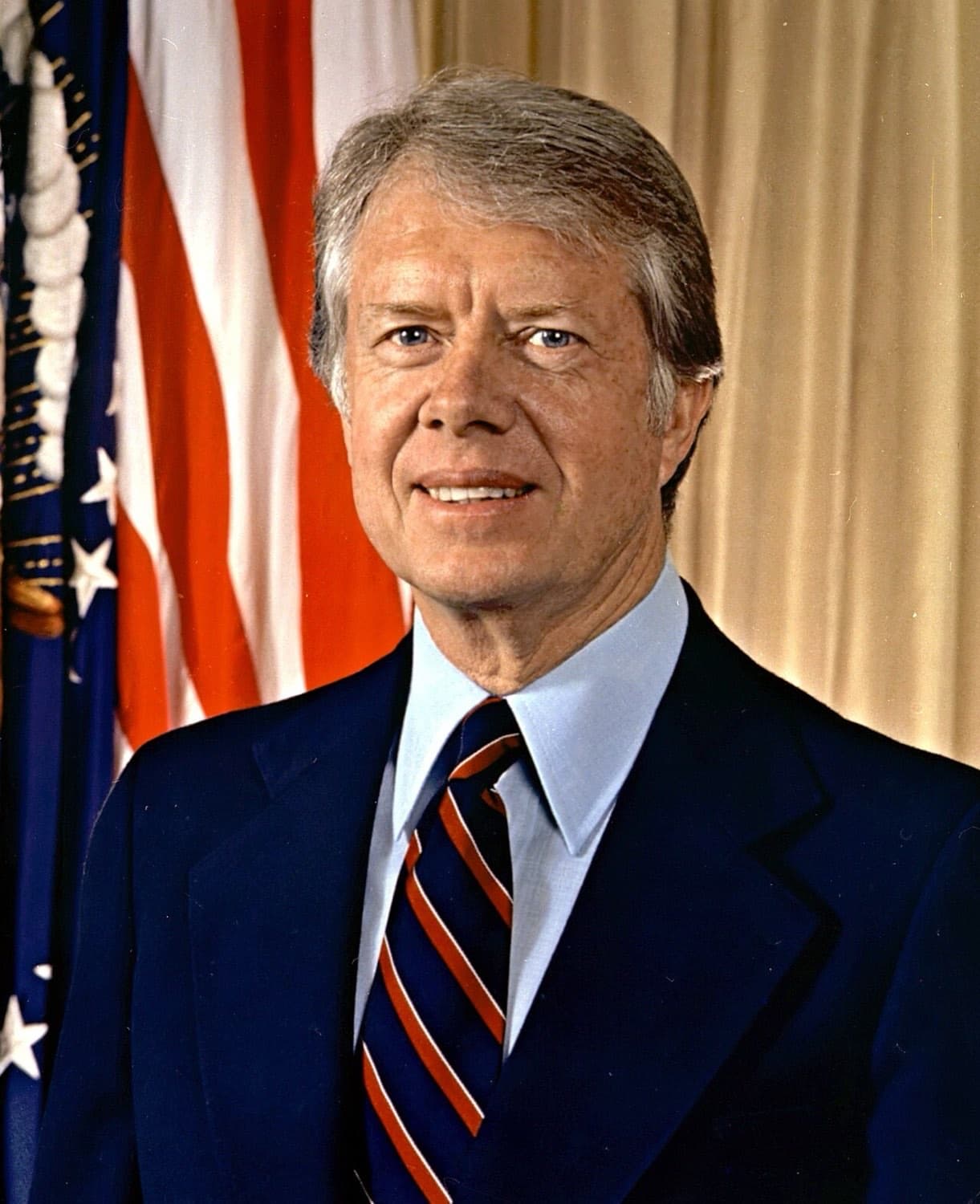
Who was Jimmy Carter?
Jimmy Carter was the 39th President of the United States from 1977 to 1981 and received the Nobel Peace Prize in 2002. He was born James Earl Carter Jr. on 1 October 1924 in Plains, a small farming town in Georgia. His father was a farmer and businessman, and his mother, Lillian Gordy Carter, worked as a nurse. He died in Plains on 29 December 2024 at the age of 100.
After graduating from the United States Naval Academy in 1946, he served as an officer on submarines in the Atlantic and Pacific fleets. Admiral Hyman Rickover chose him for the nuclear submarine program, for which he studied reactor technology and nuclear physics. In July 1946 he had married Rosalynn Smith, who also came from Plains. When his father died in 1953, he left the Navy and took over the family business, a seed and farm supply company.
In Plains he quickly became a voice of the community and served on boards for education, the hospital and the library. In 1962 he was elected to the Georgia Senate. He lost his first campaign for governor in 1966, won the next one, and in January 1971 became the 76th Governor of his state. At the end of 1974 he announced his candidacy for president.
He was elected president in November 1976 and lost his bid for re-election in 1980. For many people, what came afterwards became better known than his time in office: the Carter Center, election observation on several continents, conflict mediation and the fight against tropical diseases. He wrote 32 books and taught Sunday school at his church in Plains. After the White House he remained active in public life for around four decades.
What did Jimmy Carter stand for?
He worked to resolve conflicts through negotiation rather than violence and placed human rights at the centre of his foreign policy. In 2002 the Nobel Committee noted that, at a time still dominated by the Cold War, he gave human rights renewed weight in international politics. For him, peace, democracy and development belonged together. The prize citation names all three concerns.
A central idea of his Nobel Lecture in Oslo was that war is never a good, even when it seems necessary. He described the United Nations as the best avenue for maintaining peace and pointed to international agreements against land mines, chemical weapons and nuclear testing. He called the growing gap between the richest and the poorest people the greatest challenge facing the world. In his account it lies at the root of starvation, illiteracy, environmental degradation, violence and avoidable illness.
His faith shaped this outlook. He was a Baptist and a deacon of his church in Plains, and in Oslo he referred to Jesus as the Prince of Peace who crossed religious boundaries. At the same time he stressed that the unchanging principles of life predate modern times. In his own words, a saying of his teacher Julia Coleman stayed with him throughout his years in the White House: adjust to changing times and still hold to unchanging principles.
In practice this showed in modest, patient work. For decades Jimmy and Rosalynn Carter volunteered one week a year building homes with Habitat for Humanity. According to The Elders, the Carter Center has worked in more than 70 countries. His membership of The Elders, the group Nelson Mandela brought together in 2007, followed the same idea: independent voices who, in their own words, go where they please, meet with whom they choose and say what they believe.
From his Nobel Lecture in Oslo on 10 December 2002.
War may sometimes be a necessary evil. But no matter how necessary, it is always an evil, never a good. We will not learn how to live together in peace by killing each other’s children.
What did Jimmy Carter achieve for peace?
His best-known contribution is the Camp David Accords of 1978, which he mediated between Egyptian President Anwar Sadat and Israeli Prime Minister Menachem Begin. On this basis Egypt and Israel concluded a peace treaty. The Nobel Committee described his mediation as a contribution that on its own would have been great enough to qualify for the Nobel Peace Prize. The peace between the two states has lasted for decades.
Other agreements fall within his presidency: the Panama Canal treaties, the SALT II treaty with the Soviet Union limiting strategic nuclear weapons, and diplomatic relations with the People’s Republic of China. The Senate never ratified SALT II after the Soviet Union invaded Afghanistan at the end of 1979. According to the Miller Center, both sides nevertheless agreed to abide by its terms. At home his administration created, among other things, a Department of Energy and a Department of Education.
After the White House he built the Carter Center in Atlanta with Rosalynn Carter in 1982, a nonpartisan, nonprofit institution. He and the Center mediated between Ethiopia and Eritrea and in North Korea, Liberia, Haiti, Bosnia, Sudan and Nepal, among other places. Under his leadership the Carter Center sent more than one hundred election observation missions to the Americas, Africa and Asia. In January 2011 he led the observation of South Sudan’s independence referendum together with Kofi Annan.
Another field was health, which he saw as a condition for peace. The Carter Center leads the international campaign against Guinea worm disease, whose incidence has fallen by more than 99 percent according to The Elders. After smallpox, it could become the second human disease ever to be eradicated. When Jimmy Carter received the Nobel Peace Prize in 2002, the citation expressly included this work for economic and social development.
What criticism is there of Jimmy Carter?
Criticism focuses mainly on his presidency, which many contemporaries saw as unsuccessful. The Miller Center at the University of Virginia describes a term under difficult conditions: the energy crisis, distrust of politics after the Watergate scandal, the revolution in Iran and Soviet power politics. It names his reluctance to engage in give and take with Congress and a certain inflexibility in dealing with friends and foes. In the 1980 election he lost to Ronald Reagan.
The hostage crisis at the American embassy in Tehran from November 1979 weighed especially heavily. He froze Iranian assets and negotiated; a military rescue attempt failed, and eight soldiers were killed. The hostages were released only after he had lost the election. The Miller Center also calls the boycott of the 1980 Moscow Olympics, his response to the Soviet invasion of Afghanistan, ill-conceived.
His diplomacy after leaving office often took place outside official channels. The Miller Center calls him a “freelance ambassador” who mediated between the US State Department and volatile leaders such as Kim Il Sung of North Korea and Muammar Qaddafi of Libya. In 1994 he used this route to help the US government settle a dispute with North Korea over nuclear weapons. The Miller Center also notes that many decisions of his presidency have gained greater respect with the passage of time.
Also from his Nobel Lecture in Oslo on 10 December 2002.
The bond of our common humanity is stronger than the divisiveness of our fears and prejudices.
What is Jimmy Carter’s legacy?
Above all, he leaves the example that political office need not be the end of public responsibility. The Miller Center notes that he was more highly regarded at the time of his death than when he lost re-election in 1980. Many see his life after the White House as a model for former heads of state. He is the only US president to have received the Nobel Peace Prize after leaving office.
The peace between Egypt and Israel that he helped prepare in 1978 remains one of the most durable results of American mediation. According to the Miller Center, every succeeding president has emulated this role as mediator to varying degrees. His emphasis on human rights in foreign policy also had an effect beyond his term. In the Miller Center’s assessment it paved the way for the human rights initiatives of the 1980s and 1990s.
The Carter Center continues its work after his death in election observation, conflict mediation and health. The campaign against Guinea worm shows how much persistent, unspectacular work can achieve over decades. His library and museum in Atlanta and the national historical park in Plains keep his memory alive. His 32 books range from political memoirs to poetry and reflections on ageing.
He was one of the first members of The Elders, founded by Nelson Mandela in 2007, and remained an Elder Emeritus after stepping down in 2016. Kofi Annan, then chair of the group, praised him for bringing the gravitas of his presidential office but also the passion of an activist. For a peace platform like W3ltfrieden, one lesson stands out: peace often grows from long conversations that rarely make headlines. Jimmy Carter devoted a large part of his life to them.
Frequently asked questions
- When and where did Jimmy Carter live?
- Jimmy Carter was born in Plains, United States, and lived from 1 October 1924 to 29 December 2024.
- Why did Jimmy Carter receive the Nobel Peace Prize?
- Jimmy Carter received the Nobel Peace Prize in 2002 for decades of work to find peaceful solutions to international conflicts. The citation expressly included his work for economic and social development.
- What role did Jimmy Carter play?
- Jimmy Carter was the 39th President of the United States and founder of the Carter Center.
Sources
Life
- 1924Born on 1 October in Plains, Georgia. He grows up in nearby Archery; his father is a farmer, his mother a nurse.
- 1977On 20 January he takes office as the 39th President of the United States. Before that he was a naval officer, a farmer and Governor of Georgia.
- 1978He mediates the Camp David Accords between Egypt and Israel. They become the basis of the peace treaty between the two states.
- 1982After leaving office he founds the Carter Center in Atlanta with his wife Rosalynn and teaches at Emory University.
- 2002The Norwegian Nobel Committee awards him the Nobel Peace Prize on 10 December.
- 2007He is one of the founding members of The Elders, a group of independent leaders brought together by Nelson Mandela.
- 2024On 29 December he dies at the age of 100 in his home in Plains.
More portraits
- Kofi Annan8 April 1938 to 18 August 2018The first Secretary-General to rise from the ranks of United Nations staff, who put human rights above state sovereignty and drew lessons from the organisation’s failures
- Nelson Mandela18 July 1918 to 5 December 2013A lawyer from the Eastern Cape who, after 27 years in prison, governed without revenge and negotiated South Africa’s way out of apartheid into democracy
From role model to a mission of your own
None of these people acted alone. What connects them is the step from concern to action. That step is possible on a small scale too: in a neighbourhood, a school, a club.
Find your peace mission