How wars ended
The Dayton Agreement
Three weeks sealed off on an air force base, and at the end not merely a ceasefire but the constitution of a state
In numbers
21
days of talks
sealed off on an air force base
11
annexes
one of them is the constitution of the state
30
years without a new war
since December 1995
- Period
- November to December 1995
- Place
- Dayton, Ohio, and Paris
- Parties
- Bosnia and Herzegovina, Croatia and Serbia, mediated by the United States with the European Union and Russia involved
- Outcome
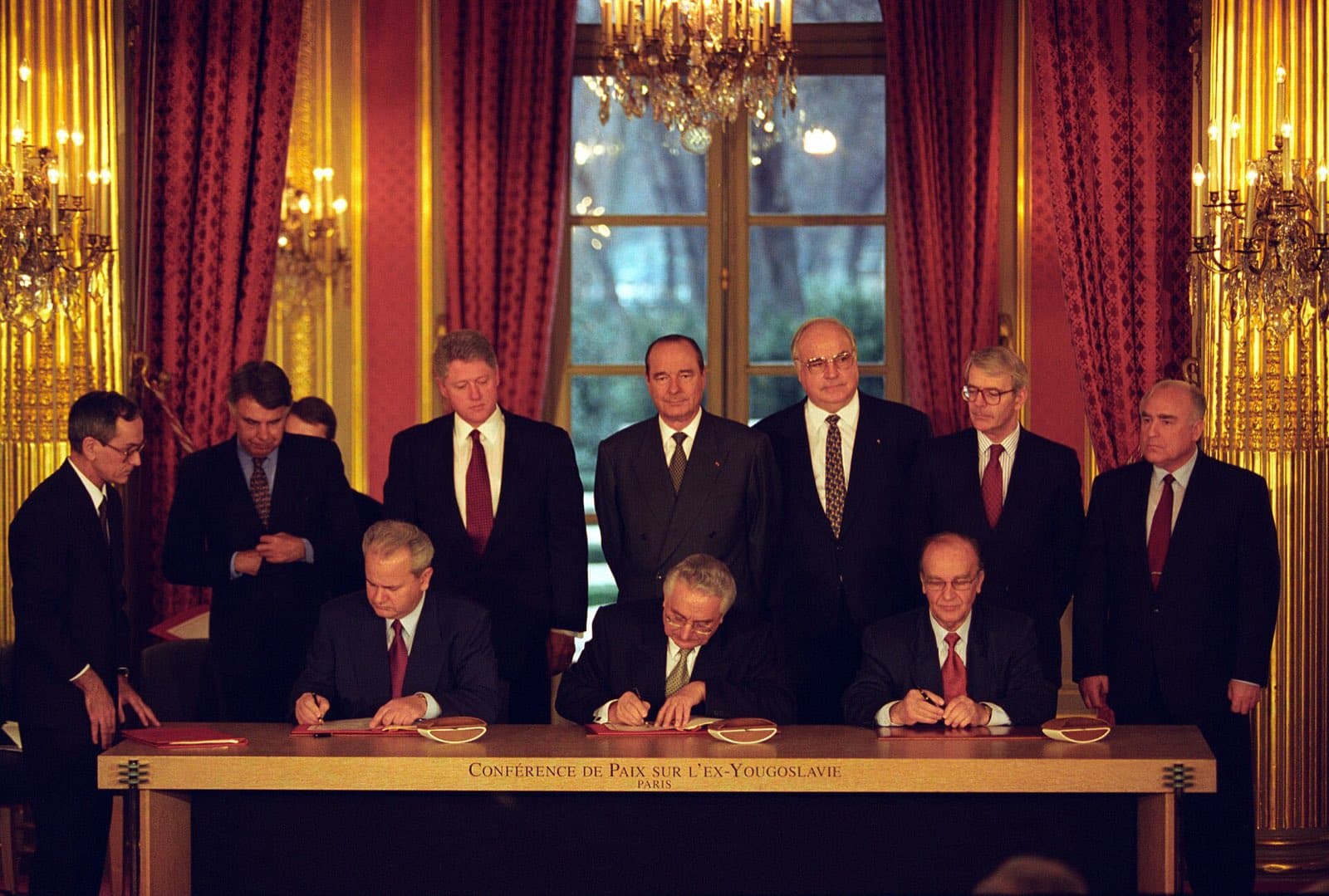
- A framework agreement with eleven annexes, initialled on 21 November 1995 and signed on 14 December 1995 in Paris
What was the Dayton Agreement?
The General Framework Agreement for Peace in Bosnia and Herzegovina ended the war that had run since April 1992. Talks were held from 1 to 21 November 1995 at an air force base in Dayton, Ohio; the signing took place on 14 December 1995 in Paris.
At the table sat the presidents of Bosnia and Herzegovina, Croatia and Serbia. The United States led the mediation, with the European Union and Russia involved.
The agreement is more than a peace settlement. It includes eleven annexes covering everything from troop withdrawal through elections and the return of refugees to policing. Annex 4 is the constitution of the state. A country thereby received its basic order as part of an international treaty.
Who negotiated, and under what conditions?
The venue was part of the method. A sealed-off military base in the United States held the delegations together for three weeks, without press and without the option of ending talks by walking out. The same technique had worked at Camp David in 1978.
The population of the country whose order was being settled took no part in the talks, and there was no vote on the result. That is the sharpest contrast with the Good Friday Agreement three years later, which was confirmed by two referendums.
What made talks possible was a changed situation in the summer and autumn of 1995, including the genocide at Srebrenica in July, which shifted the international stance fundamentally, and a ceasefire in October.
What was agreed?
Bosnia and Herzegovina remains one state within its borders but consists of two entities: the Federation of Bosnia and Herzegovina with about 51 per cent of the territory and the Republika Srpska with about 49 per cent. Each has its own government, parliament and police.
At state level there is a three-member presidency and a parliament whose seats are distributed by membership of three constituent peoples. Alongside them stands a High Representative of the international community who oversees civilian implementation with far-reaching powers.
Militarily, an international force of some 60,000 troops secured the separation of the armies and their withdrawal behind the agreed lines. That task was done within months; the civilian implementation continues.
How long did the peace hold?
Thirty years. The war has not returned, and by that measure the agreement met its first aim: it stopped the killing.
The second aim, a working common state, is harder to assess. The order that stopped the killing fixed the division along the same lines that had been fought over. Decisions at state level require the assent of all three sides, which makes deadlock the normal form of politics.
That the office of the High Representative still exists three decades after the treaty is the soberest finding about this construction. It carries the peace and has not yet made itself unnecessary.
What is there to learn from it?
Dayton ended a war in which every earlier mediation had failed. That it worked hung on three things: a changed military situation, a sealed-off venue and a mediator with means of its own. None of them was a problem of text.
The second finding is uncomfortable. An order built along the lines of a conflict makes those lines permanent. Making membership of a group the condition for holding office keeps alive the very division the conflict grew out of.
For practice that does not mean Dayton was wrong. It means an agreement has two clocks. One measures whether the violence stops, the other whether a society can do without the treaty. The second runs slower, and it is rarely read at the signing.
What follows from it
An agreement can end a war and at the same time fix in place the division that caused it. Both are in the same text.
Sources
How it unfolded
- April 1992War begins in Bosnia and Herzegovina. It lasts three and a half years and costs around 100,000 lives.
- July 1995The genocide at Srebrenica fundamentally changes the international stance towards the war.
- October 1995A ceasefire takes effect and creates the precondition for any negotiation at all.
- 1 November 1995Talks begin at Wright-Patterson Air Force Base in Dayton. The delegations are effectively unable to leave the grounds.
- 21 November 1995After three weeks the agreement is initialled. It comprises a framework and eleven annexes.
- 14 December 1995The formal signing takes place in Paris. An international force of some 60,000 troops secures implementation.
- Since 1996A High Representative oversees the civilian side. The office exists to this day, which says more about the construction than any comment.
More in this series
- The Good Friday AgreementJune 1996 to May 1998After three decades of violence, two governments and eight parties agreed on an order that the public then voted on
- The Camp David AccordsSeptember 1978 to March 1979Thirteen days without an audience, a mediator who would not let the parties leave, and at the end the first peace between Israel and an Arab state
From history to a mission of your own
Every one of these treaties was the work of people who thought it could be done. The same stance is what it takes on a small scale: in a neighbourhood, a school, a club.
Find your peace mission