How wars ended
The Camp David Accords
Thirteen days without an audience, a mediator who would not let the parties leave, and at the end the first peace between Israel and an Arab state
In numbers
13
days behind closed doors
5 to 17 September 1978
2
frameworks agreed
one became a treaty, one stayed on paper
3
years to withdrawal
Sinai fully evacuated by 1982
- Period
- September 1978 to March 1979
- Place
- Camp David, Maryland, and Washington
- Parties
- Egypt under Anwar Sadat and Israel under Menachem Begin, mediated by US President Jimmy Carter
- Outcome
- Two frameworks of 17 September 1978, out of which came the peace treaty of 26 March 1979
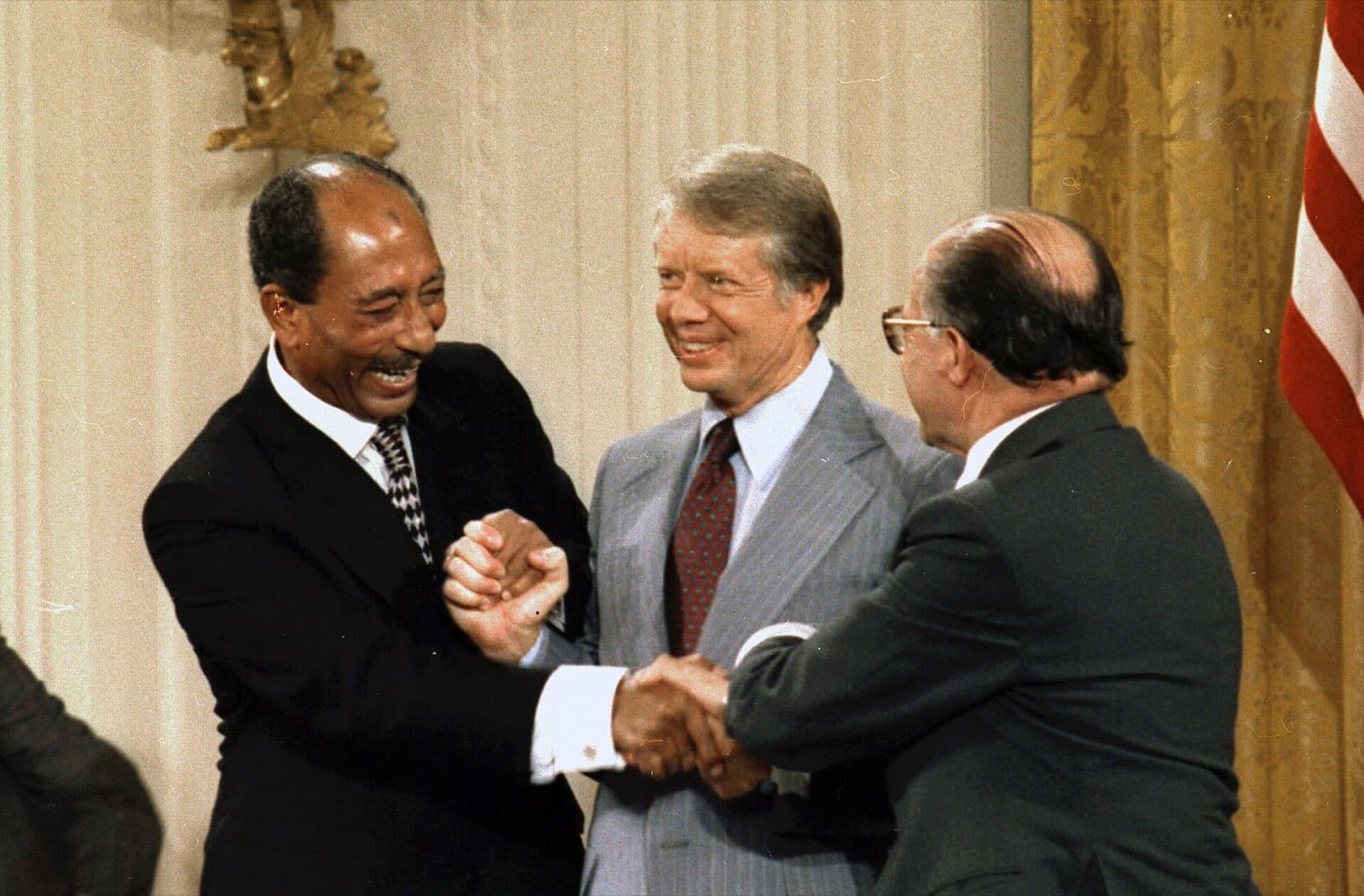
What were the Camp David Accords?
From 5 to 17 September 1978 the Egyptian president Anwar Sadat and the Israeli prime minister Menachem Begin negotiated at the US presidential retreat in Maryland. The mediator was Jimmy Carter.
Two frameworks came out of it. The first settled peace between Egypt and Israel. The second sketched a framework for the wider questions of the region, including an interim administration for the Palestinian territories.
The first framework became the peace treaty of 26 March 1979, the first ever between Israel and an Arab state. The second was never carried out.
Who negotiated, and how did it run?
The distinctive thing about the procedure was the seclusion. For thirteen days there was no press, no interim reporting and no way to defend a position at home before it had been fully negotiated. Anyone making concessions in such talks does not have to justify them publicly at the same time.
The mediator was not neutral in the sense of uninvolved. Carter had an interest of his own in the outcome, brought in his own proposals and shuttled for days between two cabins, because the two principals were at times not speaking to each other.
One step had prepared the ground: Sadat travelling to Jerusalem in November 1977 and speaking before the Knesset. Without breaking that taboo there would have been no invitation to Camp David.
What was agreed?
Israel committed to a full withdrawal from the Sinai peninsula, occupied since 1967. Egypt recognised Israel, both states guaranteed the inviolability of their borders and opened diplomatic relations. Sinai was demilitarised and is watched to this day by an international observer force.
The second framework provided for a five-year transitional period with self-government for the West Bank and Gaza, at the end of which talks on the final status were to take place.
The difference between the two parts is concreteness. The first names a territory, a deadline and two signatures. The second names a procedure whose subjects were absent from the table: the Palestinian side was not represented at Camp David and did not accept the framework.
How long did the peace hold?
The treaty between Egypt and Israel has held since 1979 and has survived every crisis in the region since. Measured in years it is the most durable settlement in this series after the Peace of Westphalia.
The price was high and paid mainly on one side. Egypt was suspended from the Arab League, the League moved its seat out of Cairo, and Sadat was assassinated in 1981. The treaty survived that too.
The second framework had no effect. The autonomy talks made no progress, and the questions it left open were taken up again fifteen years later in Oslo, again without a conclusion.
What is there to learn from it?
Camp David shows what seclusion achieves. Without an audience both sides could move their positions without defending them at home each day. It is still one of the few procedural features that recurs in many successful mediations.
The same episode also shows the limit. Where those affected by an arrangement are not at the table, the result is text without binding force. The first framework concerned two states that had both signed. The second concerned a third party that was not invited.
Both findings sit in a single pair of documents, signed on the same day by the same people. It is hard to show more plainly that the durability of an agreement depends less on its wording than on who is bound by it.
What follows from it
Two agreements on the same day, the same signatures: one held for decades, the other not a month. The difference was not in the text.
Sources
How it unfolded
- October 1973The war of October 1973 changes the situation between Egypt and Israel and makes negotiation thinkable for both.
- November 1977Sadat travels to Jerusalem and speaks before the Knesset. The visit breaks a taboo and makes direct talks possible.
- 5 September 1978Talks begin at Camp David. The parties are sealed off, with no press and no interim statements.
- 17 September 1978Two frameworks are signed: one for peace between the two states, one for settling the wider questions.
- December 1978Sadat and Begin receive the Nobel Peace Prize, before the framework has become a treaty.
- 26 March 1979The peace treaty is signed in Washington. Israel commits to withdrawing from Sinai; both states recognise their borders.
- 1979 to 1989Egypt is suspended from the Arab League. The suspension lasts ten years; the treaty outlasts it.
- April 1982The withdrawal from Sinai is complete. The second framework, meant to settle the question of autonomy, is never carried out.
More in this series
- The Peace of Westphalia1644 to 1648Envoys negotiated in two cities for five years while the war went on. What came out of it is still treated as a model for talks between enemies
- The Good Friday AgreementJune 1996 to May 1998After three decades of violence, two governments and eight parties agreed on an order that the public then voted on
From history to a mission of your own
Every one of these treaties was the work of people who thought it could be done. The same stance is what it takes on a small scale: in a neighbourhood, a school, a club.
Find your peace mission