How wars ended
The Peace of Tilsit
Prussia lost half its state and kept its existence only because a third party at the table wanted it kept
In numbers
1/2
of the territory lost
along with much of the population
42,000
ceiling on the army
written into the treaty
6
years in force
1807 until the rising of 1813
- Period
- July 1807
- Place
- Tilsit on the Memel
- Parties
- France under Napoleon, Russia under Tsar Alexander I and Prussia under Frederick William III
- Outcome
- Two treaties, with Russia on 7 and with Prussia on 9 July 1807, taking about half of Prussian territory
What was the Peace of Tilsit?
In July 1807 the war between France, Russia and Prussia ended at Tilsit in East Prussia. Two treaties were concluded: on 7 July between France and Russia, on 9 July between France and Prussia.
A military collapse had come first. The twin battles of Jena and Auerstedt in October 1806 had effectively decided the war for Prussia in a day; the defeat of the Russian army at Friedland in June 1807 took from the last ally the means to fight on.
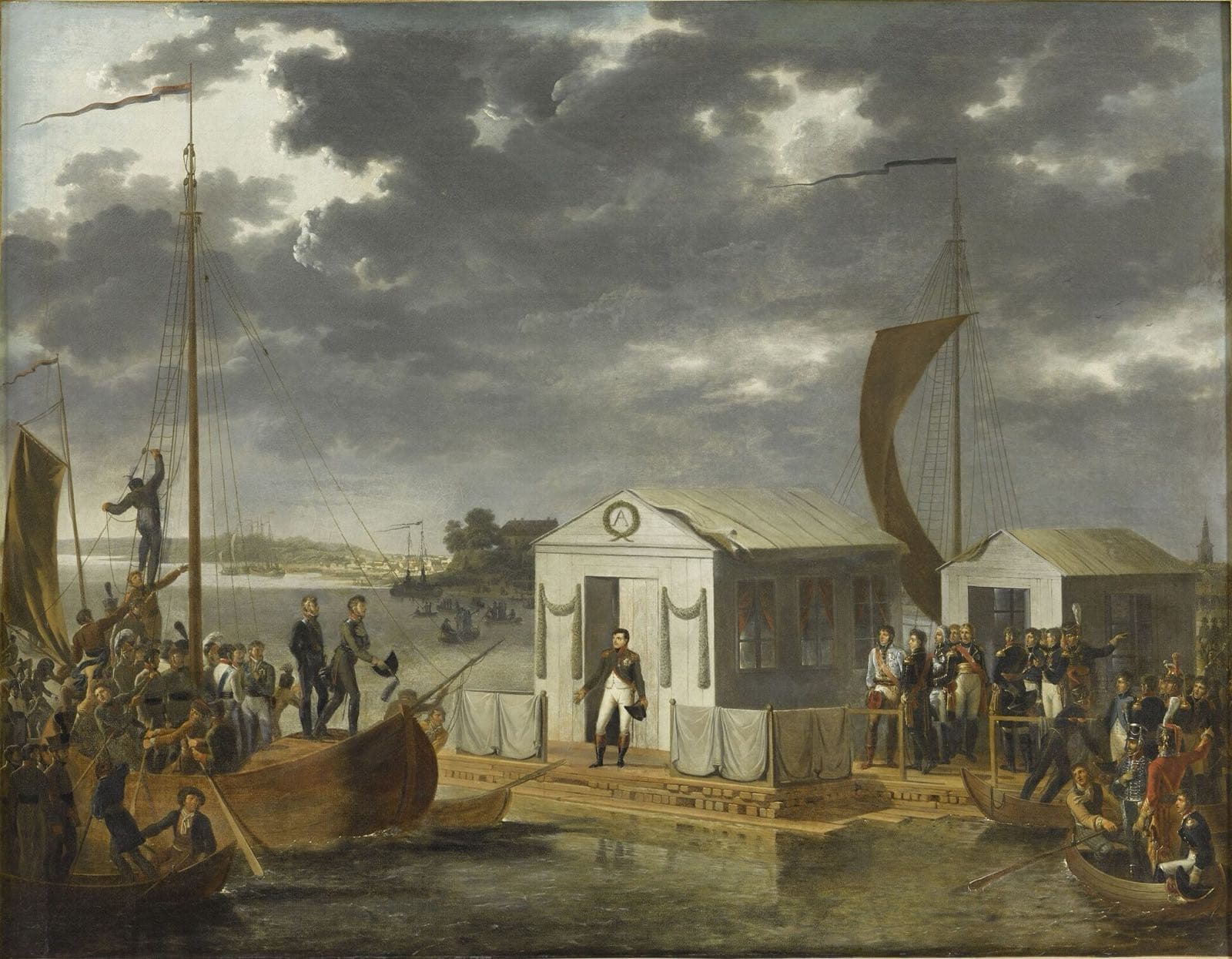
What was negotiated at Tilsit concerned Prussia without Prussia. Napoleon and Tsar Alexander I first spoke alone, on a raft moored in the river Memel. The Prussian king waited on the bank.
Who negotiated, and who was negotiated over?
Two parties negotiated: Napoleon and Alexander I. Both had reason to come to terms. France wanted Russia out of the coalition, Russia wanted the war over without losing territory itself.
Prussia was subject matter, not party. That the country remained a state at all came down to the Tsar, who insisted on it. Without that intervention the Prussian monarchy would probably have been partitioned in 1807.
Queen Louise meeting Napoleon on 6 July is among the best-known scenes of this peace and changed nothing about the result. It is an example of how little personal appeal achieves once the question of power has already been settled.
What was agreed?
Prussia lost about half its territory. The lands west of the Elbe went to the newly formed Kingdom of Westphalia, the Polish provinces acquired in the partitions to the Duchy of Warsaw.
Added to that were burdens that tied down what remained: heavy contributions, occupation of the fortresses by French troops with the exception of Silesia, a ceiling of 42,000 men for the army, and an obligation to provide troops in war.
Russia, by contrast, lost nothing and gained a partner. The same day of negotiation therefore produced opposite results for the two other parties, which says less about negotiating skill than about the situation beforehand.
How long did the peace hold?
Six years. In 1812 Napoleon's campaign against Russia failed, and in 1813 Prussia re-entered the war. The treaty of Tilsit was finished.
In those six years, though, something happened that outlasted the treaty. From October 1807 a series of reforms began in Prussia: the end of hereditary subjection, municipal self-government with elected representatives, a rebuilding of administration and army, the founding of the university in Berlin in 1810.
The reforms were not a programme born of insight but an answer to defeat. A state permitted only 42,000 men under arms had to find its strength elsewhere, and the army reform laid the ground for what followed in 1813.
What is there to learn from it?
The first sentence is the hardest in this series: whoever is not at the table is on the agenda. Prussia was negotiated over in 1807, not included, and the survival of its own state hung on a third party's interest.
The second finding does not soften the first but adds to it. A dictated peace fixes the terms, not what the defeated side makes of them. The Prussian reforms happened inside the limits of that treaty, not against them.
Read together for today: a result one side was not allowed to shape is not a peace but a pause. And what happens during that pause helps decide what comes next.
What follows from it
Whoever is not at the table is on the agenda. How well that turns out is then decided by others.
Sources
How it unfolded
- October 1806The twin battles of Jena and Auerstedt decide the war within a single day. The Prussian state collapses militarily.
- 14 June 1807The defeat of the Russian army at Friedland takes from Prussia's last ally the means to keep fighting.
- 25 June 1807Napoleon and Tsar Alexander I meet on a raft moored in the Memel. Prussia is not present at that conversation.
- 6 July 1807Queen Louise asks Napoleon in private for milder terms. It changes nothing about the outcome.
- 7 July 1807France and Russia sign their treaty. The Tsar secures in it that Prussia continues to exist as a state.
- 9 July 1807The treaty with Prussia is signed. The country loses its lands west of the Elbe and its Polish provinces.
- From October 1807The Prussian reforms begin: emancipation of the peasantry, municipal self-government, reform of the army. The rebuilding is an answer to the defeat.
More in this series
- The Congress of ViennaOctober 1814 to June 1815After more than twenty years of war, the European powers negotiated a new order in Vienna. What came out of it held longer than anything before it
- The Treaty of VersaillesJanuary 1919 to January 1920On 28 June 1919 the parties signed a treaty in the Hall of Mirrors at Versailles that only one side had drafted. How long it could hold was decided by that
From history to a mission of your own
Every one of these treaties was the work of people who thought it could be done. The same stance is what it takes on a small scale: in a neighbourhood, a school, a club.
Find your peace mission