How wars ended
The Congress of Vienna
After more than twenty years of war, the European powers negotiated a new order in Vienna. What came out of it held longer than anything before it
In numbers
9
months of talks
October 1814 to June 1815
5
leading powers
plus dozens of smaller states
39
states in the German Confederation
roughly; the number changed later
- Period
- October 1814 to June 1815
- Place
- Vienna
- Parties
- Austria, Prussia, Russia, Great Britain and France, along with envoys from numerous smaller states
- Outcome
- A reordering of the continent and the German Confederation, set down in the Final Act of 8 June 1815
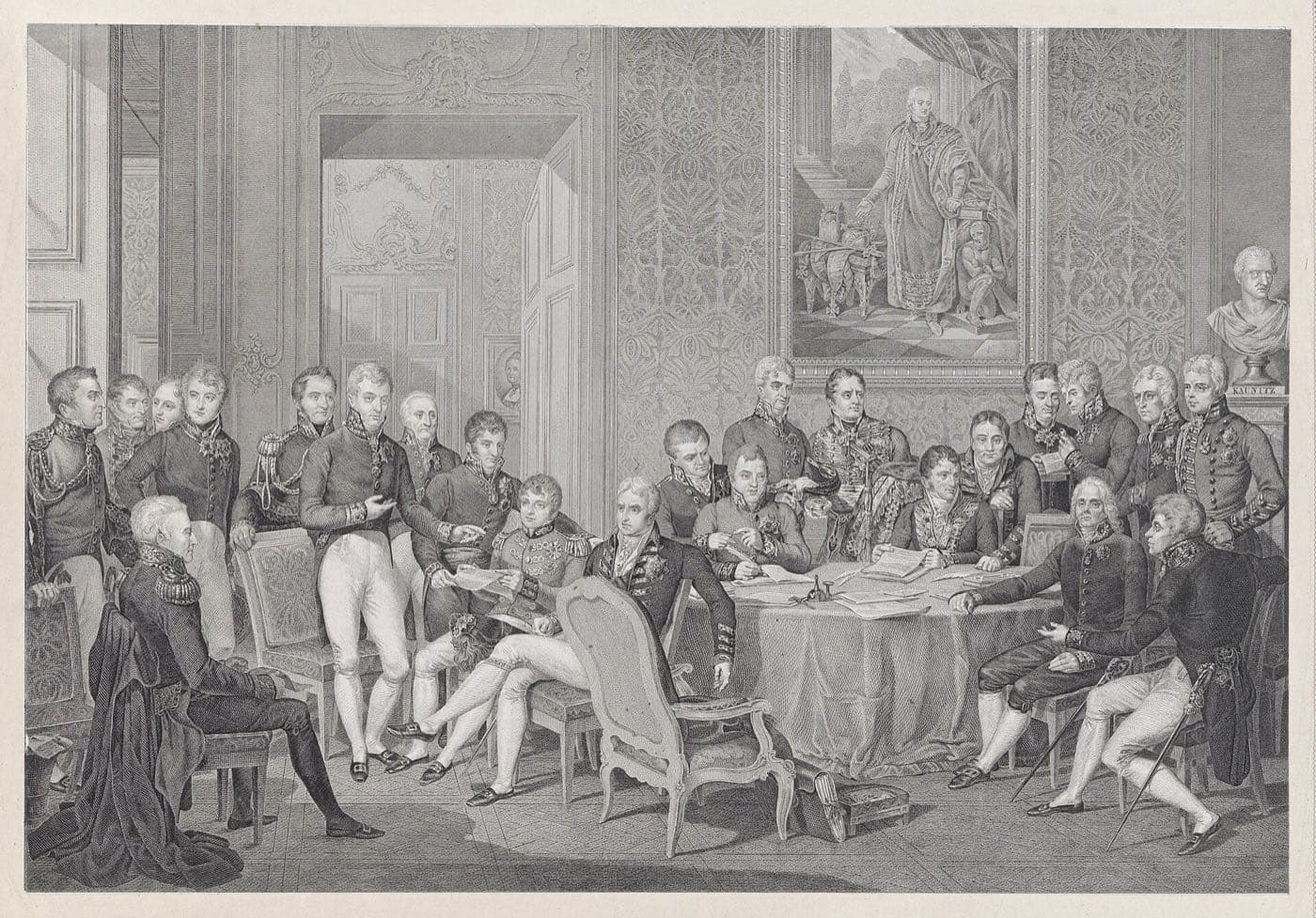
What was the Congress of Vienna?
From October 1814 to June 1815, statesmen and diplomats gathered in Vienna to reorder a continent that revolution and war had shaken for two decades. The gathering was led by the Austrian state chancellor Clemens von Metternich.
The congress was not a peace treaty in the narrow sense. The First Peace of Paris of 30 May 1814 had already ended the war and expressly referred the open questions to a later gathering. So Vienna was not about whether there would be peace but on what terms.
Talks ran for nine months in shifting groups, often away from the official sessions. What came of it was the Final Act of 8 June 1815, a bundle of agreements rather than a single treaty.
Who negotiated, and to what end?
The tone was set by the four powers that had defeated Napoleon: Austria, Prussia, Russia and Great Britain. France sat at the table as the loser and regained weight as the talks went on. Envoys from numerous smaller states competed for their place in the new order.
The stated aim was to restore conditions as they had stood before the French Revolution. The second, unstated aim was more practical: prevent future revolutions and make sure no single power could dominate the continent again.
Together those two aims explain the peculiar character of this settlement. Outwardly it was built for balance; inwardly, for standstill.
What was agreed?
Borders were redrawn, territories exchanged, dynasties restored. For the German-speaking lands the most consequential decision was the German Confederation: an association of sovereign states in place of the dissolved old empire, set down in the Federal Act that became part of the Final Act of 8 June 1815.
Behind it stood a principle that reached beyond the individual decisions: a balance of power in which no state should be strong enough to overwhelm the others. That thinking shaped European diplomacy for the rest of the century.
In September 1815 it was joined by the Holy Alliance between Russia, Austria and Prussia. It presented itself as a community of values and worked in practice as an alliance against any movement that unsettled the new order.
How long did the peace hold?
Decades followed without a major war between European states. The nineteenth century has for that reason been called the most peaceful period in European history. Measured against the twenty years before it, that is the most remarkable finding about these negotiations.
The settlement survived a hard test along the way. Napoleon returned to France in the middle of the talks; only his defeat at Waterloo on 18 June 1815 closed that episode. What Vienna had agreed was then confirmed rather than renegotiated.
Inside those states it looked different. The Carlsbad Decrees of September 1819 brought censorship and surveillance of the universities, along with a central investigating commission in Mainz. Pressure built for decades until it broke out in the revolutions of 1848. The congress made peace between states, not freedom within them.
What is there to learn from it?
That peace can be negotiated, even after twenty years of war and between opponents who were fighting each other until recently. And that it takes time: the parties sat together for nine months, and the real work began once the weapons had long fallen silent.
The limit is just as clear. A peace that only secures the absence of war while passing over what people inside those states want stays brittle. Peace research calls that negative peace, as against positive peace, where the conditions violence grows out of are absent too.
Two things follow for today. First: peace has to be made, and that takes time. Second: a ceasefire is a beginning, not a result. Both hold between states as much as between neighbours.
What follows from it
A peace that only silences the weapons is stable and still unfinished. The rest begins afterwards.
Sources
How it unfolded
- 23 April 1814An armistice ends the fighting. Napoleon has abdicated and the war is decided, but the order that follows is open.
- 30 May 1814The First Peace of Paris is signed. It settles relations with France and refers everything else to a congress.
- October 1814The congress opens under the Austrian state chancellor Clemens von Metternich.
- 8 June 1815The Final Act is signed. It contains the Federal Act and with it the German Confederation, an association of sovereign states.
- 18 June 1815Napoleon is defeated at Waterloo. The Second Peace of Paris follows and confirms what was agreed in Vienna.
- September 1815Russia, Austria and Prussia found the Holy Alliance. The peace settlement becomes an alliance against change.
- September 1819The Carlsbad Decrees bring censorship and surveillance of the universities. Peace abroad is paid for with repression at home.
More in this series
- The Peace of Westphalia1644 to 1648Envoys negotiated in two cities for five years while the war went on. What came out of it is still treated as a model for talks between enemies
- The Treaty of VersaillesJanuary 1919 to January 1920On 28 June 1919 the parties signed a treaty in the Hall of Mirrors at Versailles that only one side had drafted. How long it could hold was decided by that
From history to a mission of your own
Every one of these treaties was the work of people who thought it could be done. The same stance is what it takes on a small scale: in a neighbourhood, a school, a club.
Find your peace mission