How wars ended
The Peace of Augsburg
When the dispute over faith could not be decided, the parties agreed to stop fighting it out. That makeshift held for more than sixty years
In numbers
63
years without a war of faith
1555 to 1618
2
recognised confessions
the old church and the Confessio Augustana
1555
proclaimed at Augsburg
at the imperial diet on 25 September
- Period
- February to September 1555
- Place
- Augsburg
- Parties
- King Ferdinand I on behalf of the Emperor, and the ecclesiastical and secular imperial estates of both confessions
- Outcome
- An imperial law of 25 September 1555 recognising the Confessio Augustana alongside the old church
What was the Peace of Augsburg?
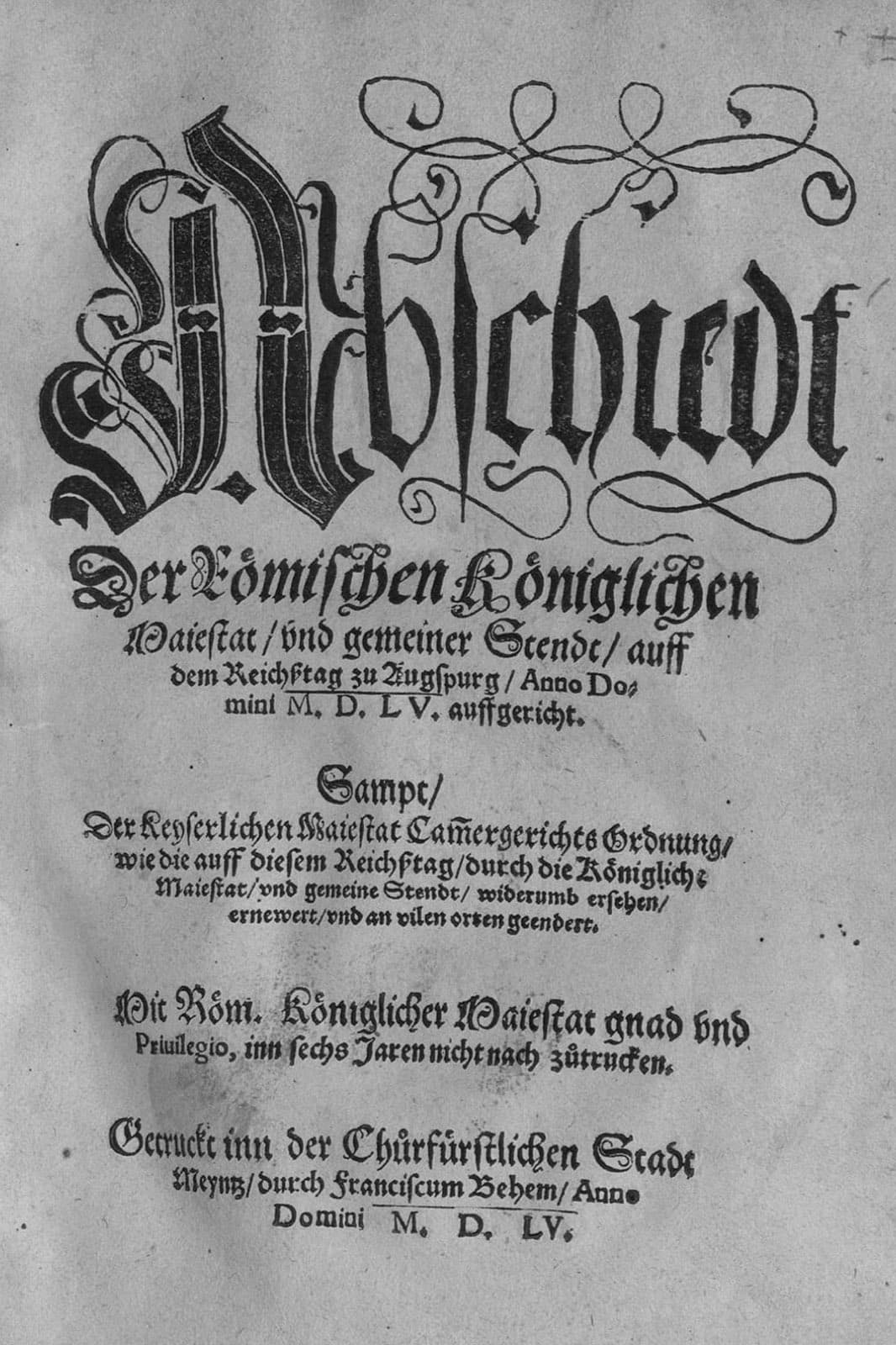
The Peace of Augsburg of 25 September 1555 is the first lasting settlement under which two Christian confessions were allowed to exist side by side in the Holy Roman Empire. It was passed at the imperial diet in Augsburg as part of the imperial recess, making it imperial law rather than a treaty between two parties.
Three decades of conflict and one war had come first. In the Schmalkaldic War of 1546 and 1547 the Emperor had tried to settle the question of faith by force and had settled nothing despite military success. The Treaty of Passau of 1552 created a truce and referred the matter to the diet.
What was decided there was neither a reconciliation nor a commitment to toleration. It was an arrangement that took an undecidable dispute out of politics by delegating it to the territorial rulers.
Who negotiated, and why not the Emperor?
At the table sat the imperial estates of both confessions: ecclesiastical and secular princes and the imperial cities. The talks were led by King Ferdinand I, brother of Charles V.
The Emperor himself stayed away. For him, recognising a second confession in the Empire was incompatible with his understanding of his office; he had defended the unity of the church all his life. A year after the religious peace he laid down his rule.
That circumstance is part of the result. The peace came about because the negotiation passed to someone who could conduct it without recanting his own life work. In mediation that is not a footnote but often the condition for anything being signed at all.
What was agreed?
The Confessio Augustana, the Lutheran confession of 1530, was recognised as lawful alongside the old church. Territorial rulers gained the right to determine the confession of their lands. The shorthand about whose realm decides the religion does not come from the text of 1555; it was coined decades later.
For subjects unwilling to follow their ruler's confession, the settlement provided a right to emigrate. By present-day standards that is not freedom of belief, but it was more than had applied before.
Two provisions stayed contested. The ecclesiastical reservation held that a prince-bishop converting to the new confession lost his office and his territory. And the Reformed faith was not included; it was recognised only in 1648. Both gaps turned out to be the fault lines.
How long did the peace hold?
For sixty-three years there was no war of faith in the Empire. Measured against the decades before it and against what came after, that is the remarkable figure about this settlement.
It worked as long as the cases were clear. Where a territory plainly held one confession, the assignment held. Conflict arose where the text left gaps: in ecclesiastical territories, in cities with mixed populations, and among the Reformed, who did not appear in the text and whose numbers grew.
Those unregulated cases piled up over two generations until the institutions of the Empire could no longer absorb them. In 1618 the Thirty Years War began. Its end in 1648 brought no new idea but the same construction with the gaps closed: a cut-off date for holdings, a third recognised confession, procedures for disputes.
What is there to learn from it?
The first finding is encouraging. A question people were willing to fight over could be shut down without being answered. Nobody had to give up their faith for the war to end. It was enough that everyone accepted a rule about who decides what.
The second finding is the warning. A settlement is exactly as stable as its exceptions. The ecclesiastical reservation and the missing recognition of the Reformed were the price of agreement in 1555, and both grew more expensive over decades because no procedure was provided for settling them later.
For any mediation that means: the hard part is not the main clause but the question of what happens to the cases it does not cover. Leaving them open postpones a conflict rather than ending it.
What follows from it
A dispute can be shut down without being decided. How long that holds depends on how precisely the exceptions are settled.
Sources
How it unfolded
- 1530The Confessio Augustana is presented at the Augsburg diet, the confession whose recognition will be fought over for a quarter of a century.
- 1546 to 1547In the Schmalkaldic War the Emperor tries to settle the question of faith by force. Victory in the field does not end the dispute.
- August 1552The Treaty of Passau creates a provisional peace and refers the decision to the next imperial diet.
- February 1555The diet convenes at Augsburg. Charles V stays away; his brother Ferdinand I leads the talks.
- 25 September 1555The religious peace is proclaimed as part of the imperial recess. It stands as imperial law, not as a treaty between two parties.
- From 1555The ecclesiastical reservation, under which a converting prince-bishop loses his office, remains contested between the confessions.
- 1618The Defenestration of Prague opens the Thirty Years War. It ends in 1648 with a settlement built on the one of 1555.
More in this series
- The Peace of Westphalia1644 to 1648Envoys negotiated in two cities for five years while the war went on. What came out of it is still treated as a model for talks between enemies
- The Good Friday AgreementJune 1996 to May 1998After three decades of violence, two governments and eight parties agreed on an order that the public then voted on
From history to a mission of your own
Every one of these treaties was the work of people who thought it could be done. The same stance is what it takes on a small scale: in a neighbourhood, a school, a club.
Find your peace mission