How wars ended
The Treaty of Brest-Litovsk
In March 1918 the war on the eastern front ended with a treaty dictated by one side. Eight months later it was void
In numbers
8
months in force
March to November 1918
4
central powers at the table
German Empire, Austria-Hungary, Ottoman Empire, Bulgaria
1/3
of the population ceded
along with more than half of industry
- Period
- December 1917 to November 1918
- Place
- Brest-Litovsk, today Brest
- Parties
- Soviet Russia on one side; the German Empire, Austria-Hungary, the Ottoman Empire and Bulgaria on the other
- Outcome
- A separate peace of 3 March 1918, made void by the armistice of 11 November 1918
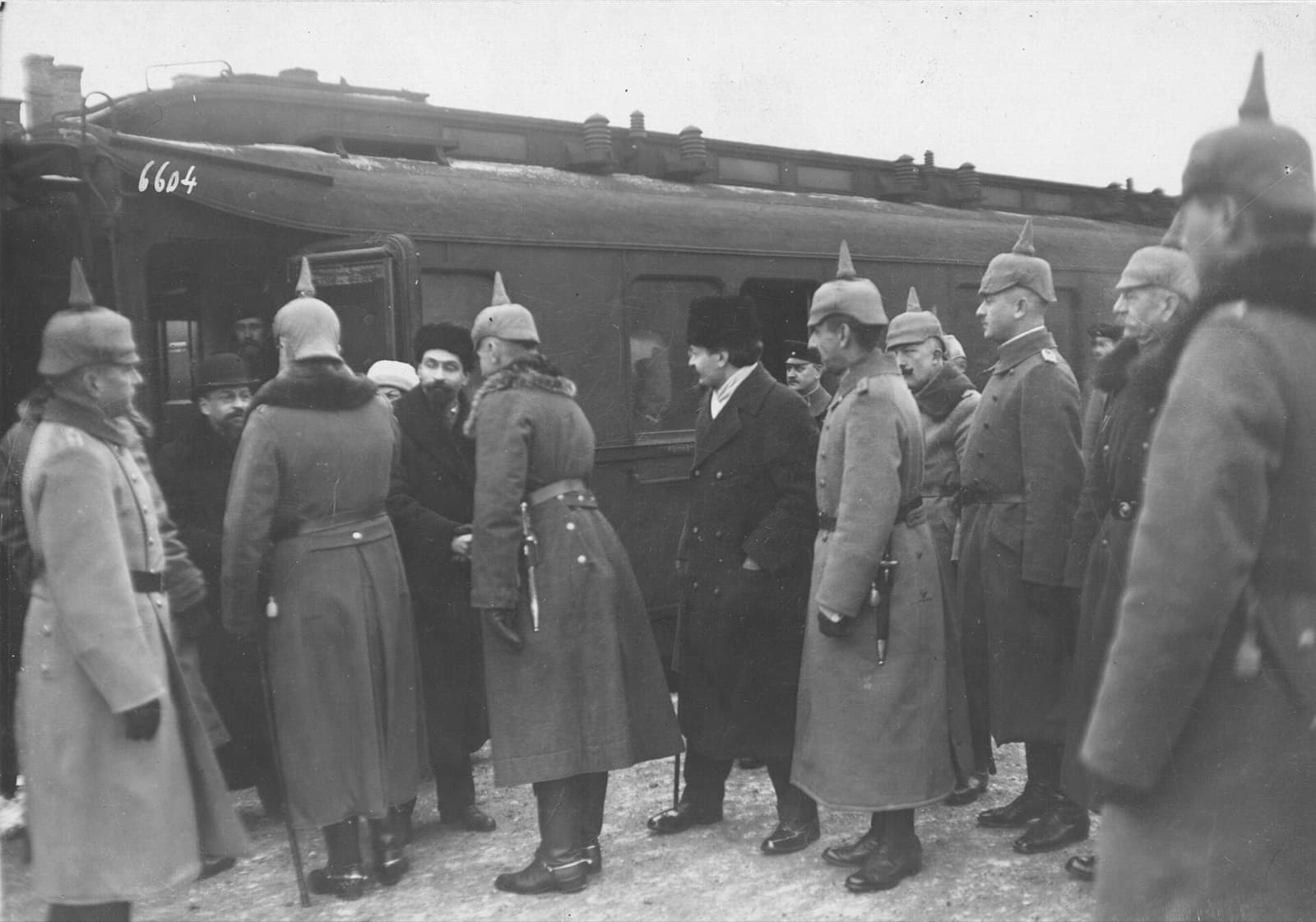
What was the Treaty of Brest-Litovsk?
On 3 March 1918 Soviet Russia and the four central powers signed a separate peace at Brest-Litovsk. It ended the First World War on the eastern front while the war in the west continued.
A political upheaval had come first. The government that took power in Petrograd in November 1917 had made an immediate end to the war one of its central aims and, in the Decree on Peace, called for talks without territorial gains or indemnities.
The other side accepted the offer but not the condition. An armistice took effect on 15 December 1917 and talks opened a week later at the headquarters of the German supreme command in the east. The venue itself already reflected the balance of power.
Who negotiated, and under what pressure?
On one side stood the delegations of the German Empire, Austria-Hungary, the Ottoman Empire and Bulgaria, led in practice by the German supreme command, whose views prevailed over those of the civilian leadership. On the other stood a government that had been in office for a few weeks and whose army was dissolving.
The Russian delegation tried to make time its ally, expecting that revolutionary movements in central Europe would change the situation. Out of that came the formula of 10 February 1918, "neither war nor peace": the talks were broken off, the war declared over and nothing signed.
It did not work. On 18 February the central powers resumed their advance and moved far east within days. The signature of 3 March came on harder terms than the ones refused three weeks earlier.
What was agreed?
Soviet Russia gave up rule over large territories in the west of the former Tsarist empire, among them Poland, the Baltic lands, Finland and Ukraine. Taken together that amounted to roughly a third of the population, more than half of industry and most of the coal reserves.
A second treaty had prepared the ground. On 9 February 1918 the central powers had made their own peace with the Ukrainian People's Republic, meant to secure grain deliveries and known for that reason as the bread peace. It removed a lever from the Russian delegation before the main question was settled.
Economic provisions and a later supplementary agreement on payments were added. The treaty was therefore not a settlement between two sides but the fixing of an imbalance. Contemporaries and historians alike call it a dictated peace.
How long did the peace hold?
Eight months. The armistice of Compiègne of 11 November 1918 obliged the German Empire to renounce the treaty, which made it void before its provisions had been carried out.
Militarily it had served its purpose for the central powers: troops moved from the east to the western front. Politically, occupying the ceded territories continued to tie down large formations, so the relief fell short of what had been hoped for.
For the other side the treaty bought time despite the losses. The government in Moscow had ended the war abroad and could turn to the civil war at home. A treaty can be a defeat and an instrument for the same party at once.
What is there to learn from it?
In this series Brest-Litovsk is the counter-case. It shows what a peace treaty is when only one side shapes it: a snapshot of the balance of power. Change that balance and the treaty changes too, not by negotiation but by lapsing.
It also illustrates a distinction familiar in peace research since Johan Galtung. Negative peace is the absence of violence. Positive peace also requires the absence of the conditions violence grows out of. The treaty of 1918 did not even secure the first for long, because it settled nothing both sides had an interest in.
In practice: the question about an agreement is not how good the terms are for the stronger side, but what the weaker side holds in it that it is willing to defend. Without that, the treaty is only a pause until the situation shifts again.
What follows from it
A treaty resting only on the balance of power on the day it is signed ends with that balance.
Sources
How it unfolded
- 8 November 1917The new government in Petrograd issues the Decree on Peace and calls for talks without territorial gains or indemnities.
- 15 December 1917An armistice takes effect. The eastern front falls quiet while the terms are discussed.
- 22 December 1917Talks open at the headquarters of the German supreme command in the east, at Brest-Litovsk.
- 9 February 1918The central powers sign a separate peace with the Ukrainian People's Republic, weakening the Russian position at the table.
- 10 February 1918The Russian delegation breaks off the talks with the formula "neither war nor peace", without signing.
- 18 February 1918The central powers resume their advance and move far to the east within days.
- 3 March 1918The treaty is signed, on harder terms than the ones refused in February.
- 11 November 1918The armistice of Compiègne obliges the German Empire to renounce the treaty. It is void from then on.
More in this series
- The Treaty of VersaillesJanuary 1919 to January 1920On 28 June 1919 the parties signed a treaty in the Hall of Mirrors at Versailles that only one side had drafted. How long it could hold was decided by that
- The Peace of TilsitJuly 1807Prussia lost half its state and kept its existence only because a third party at the table wanted it kept
From history to a mission of your own
Every one of these treaties was the work of people who thought it could be done. The same stance is what it takes on a small scale: in a neighbourhood, a school, a club.
Find your peace mission